
The Inspection Ledger: Count the People Before You Count the Machines
Over the past decade, investment in bridge and tunnel structural monitoring has been almost entirely focused on "online sensing": strain gauges, accelerometers, cable-force sensors and GNSS relentlessly converting the structure's internal state into data. Yet an awkward fact remains — the heaviest part of the formal assessment still comes from "looking". Under the highway bridge maintenance codes, routine inspection is required at least once a month and detailed inspection at most once every three years, and it still relies on inspection vehicles, scaffolding and the human eye. An online system can see a strain anomaly, but it cannot answer "how wide is the crack, where exactly is the spalling, how far has the corrosion gone".
That human ledger is not cheap. A single detailed inspection of a long-span bridge routinely means lane closures, scaffolding and an access-at-height team working continuously for one to two weeks; reaching canyon bridges, tall piers or the upper sections of stay cables poses a safety risk in itself. In late 2023 the Ministry of Transport launched pilot projects for automated, rapid and digitalised ("three-isation") highway bridge inspection, and the direction was stated bluntly: use equipment to replace people climbing, entering and going up the towers. Drones are the fastest-moving branch of that substitution.
The Dock Turns the Drone into Infrastructure
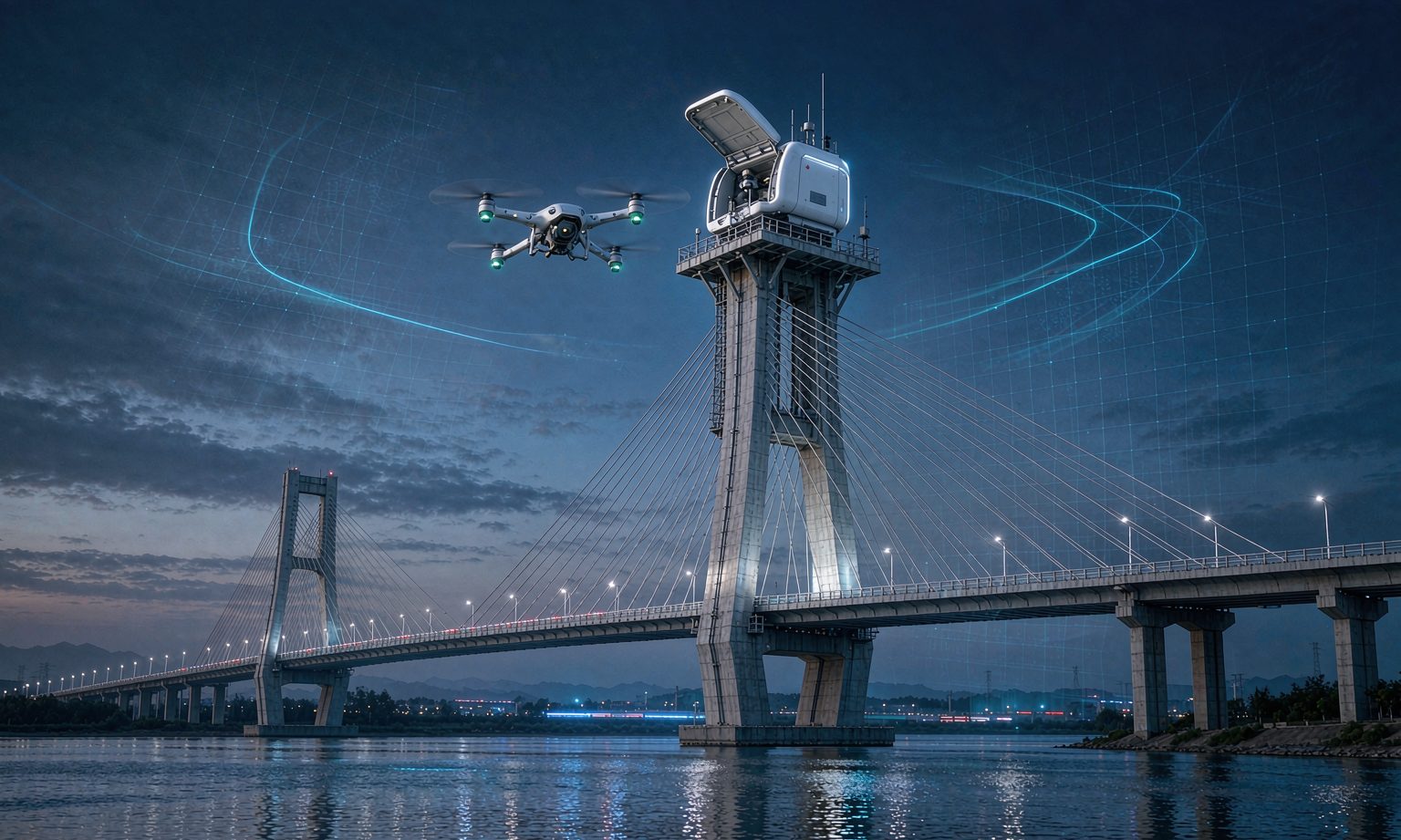
Drone inspection is not new; the real change is the automated dock — the "drone-in-a-box" hangar. It is an unattended enclosure with an automatically opening lid, a precision landing pad, a charging/battery-swap module and a data backhaul link. The drone lives inside, taking off, flying its route and returning to the dock on schedule. When the Interim Regulations on the Administration of Unmanned Aircraft Flights took effect in January 2024, routine operations by light and small UAVs in approved airspace gained a clear compliance framework, and dock deployment moved from pilots in a few industries such as power utilities and public security to scale rollout across infrastructure sectors.
Economics is what made this round of rollout possible. Take mainstream second-generation docks released after 2024: the price of a complete set including the aircraft has fallen from over a hundred thousand yuan for the first generation to the tens of thousands, weight is down to about 35 kg, and an ordinary bridge maintenance access road or the roof of a maintenance station is enough to install one. A single aircraft covers a radius of about 10 km, and a 30-minute charge is enough for the next sortie. In other words, one dock can cover the routine exterior inspection of a bridge, a cluster of tunnel portals or a stretch of slope, turning what used to be "half a day a month, two or three people, one vehicle" into a daily, unattended automated round. The power industry has already provided the reference point: autonomous drone inspection now accounts for more than 80% of transmission-line inspection at the State Grid, and manual tower climbing has been largely retired at most provincial companies. Highway structural O&M is tracing almost exactly the same curve.
Under the Deck and in the Gorges: The Hard Part Is Not Flying, It Is Positioning and Seeing
For structural inspection, the dock solves "go and look once a day". Seeing clearly involves two hard bones.
The first is positioning. The airspace above a bridge deck is open and RTK satellite positioning works well; but under the deck, along the top flanges inside box girders or on the back faces of arch ribs, satellite signals are blocked and corrupted by multipath, centimetre-level positioning fails outright, and the risk of flying into the girder during close-range flight rises sharply. The current engineering answer is visual positioning and lidar SLAM: downward-facing cameras matched against pre-made textures or the structure's own surface, plus real-time mapping from an onboard lidar, bring positioning error back under 10 cm in places with no satellite signal. This is why "under-deck bridge inspection" has moved from a no-go zone for consumer drones to a routine mission for industry-grade aircraft fitted with visual positioning modules.
The second is seeing. The core metric in crack assessment is width, and the codes require observation precision down to 0.2 mm. A conventional hover shot from 10 m away with an ordinary camera yields a ground sampling distance of 2–3 mm — enough to find a crack but not to measure one. Measuring requires closing to 3–5 m and pushing the sampling distance to the 0.5 mm class. The mainstream general-purpose approach today is a "two-pass flight": the first pass covers everything at conventional altitude for an AI-screened census, and the second pass automatically plans close-range re-flights over suspect areas to capture measurable detail imagery. A bridge-fleet pilot run by a provincial transport group has published these figures: a full exterior inspection of a kilometre-scale bridge takes about 40 minutes, and after AI detection plus human review, the accuracy of detecting surface defects — cracks, spalling, exposed rebar — exceeds 90%, with misses concentrated in cracks covered by staining, a point to which this article returns.
From a Pile of Photos to a 3D Base
A single inspection produces thousands of photos, and unless you solve "where do the photos hang", the second sortie becomes a data disaster. The prevailing industry approach is to land inspection results onto a reality-captured 3D model:
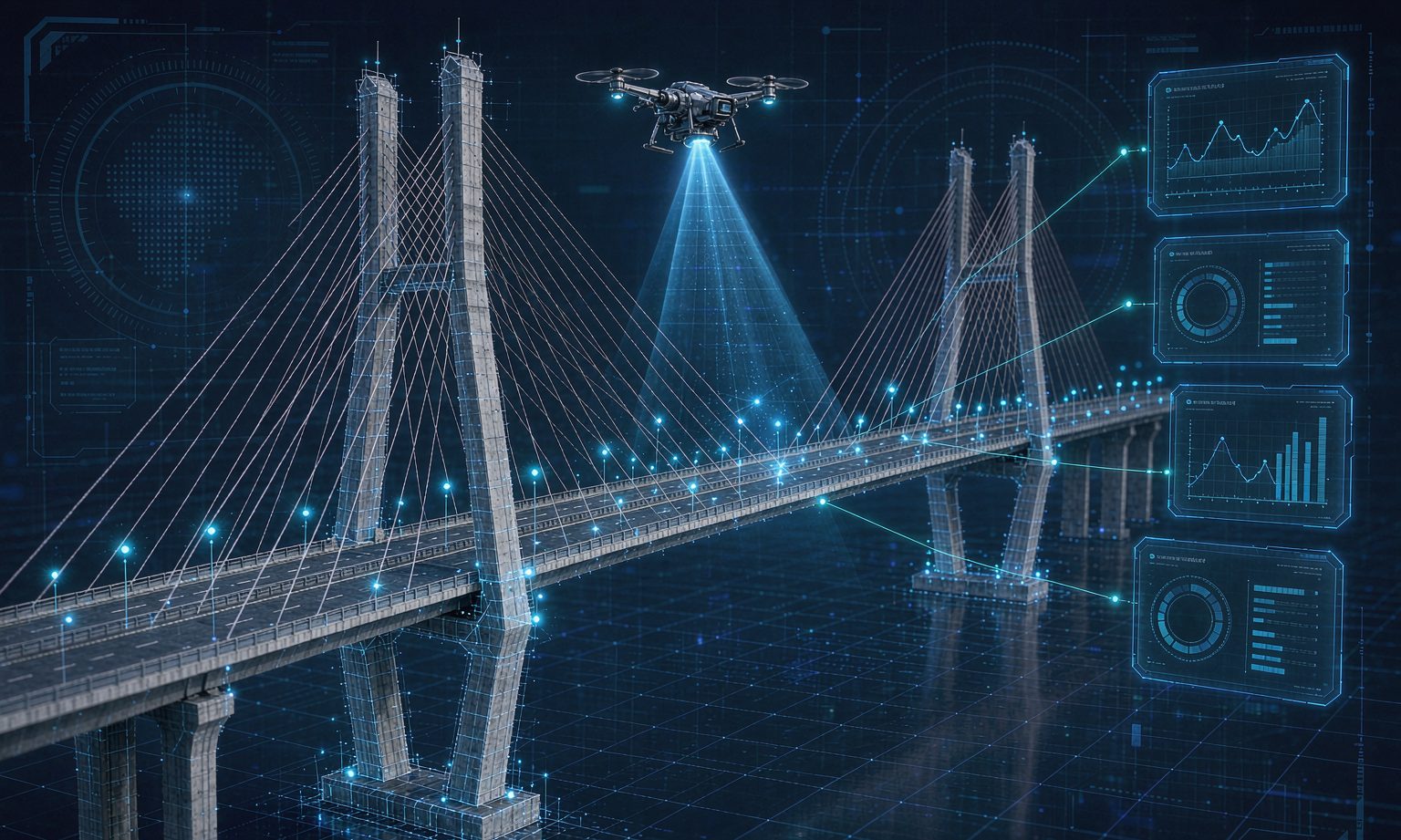
Use oblique photogrammetry or drone-borne lidar to build one fine 3D reconstruction of the bridge, tunnel portals and slopes, producing a centimetre-accurate reality model that serves as the static base. Every subsequent inspection flight's photos then attach automatically to the corresponding part of the model via positioning data, and each crack, each spalled patch identified by the AI becomes a geo-referenced, time-stamped "defect annotation" on the model. Stacking the annotations from multiple inspections of the same location naturally produces a defect development curve — whether a crack is stable, growing slowly or accelerating turns from "a line in each inspection report" into time-series data you can click open on the model.
The significance of this step goes beyond inspection. A static 3D base + dynamic defect annotations + real-time data from online sensors, all stacked in one coordinate frame, is the minimum viable form of a structural digital twin. Many previous "digital twins" had nothing but sensor curves and lacked a spatial carrier that could hold defect annotations; dock inspection happens to supply exactly that carrier.
Reconciling the Static Model with the Dynamic Data
Once interior and exterior data streams are genuinely fused, they can answer questions neither stream can answer alone. Two typical scenarios:
Scenario one: a strain anomaly triggers an exterior cross-check. The online system reports that the daily mean strain of a girder segment has risen 5% for a week straight. The traditional response is dispatching a structural engineer to investigate on site. In the fused setup, the engineer clicks the segment on the 3D model and pulls up the dock's last 30 days of automatic inspection imagery: if crack width in that zone has simultaneously grown from 0.1 mm to 0.25 mm, escalate immediately; if the exterior is unchanged, investigate thermal effects or sensor drift first. Alarm grading shifts from "single-metric thresholds" to "interior–exterior cross-validation", and the cost of chasing false alarms falls substantially.
Scenario two: a defect triggers intensified observation. When a detailed inspection or AI review finds that a crack at a critical location has entered an expanding band, the dock's route is automatically updated to a daily close-range re-flight of that location, building a high-frequency exterior time series until the trend converges. This "defect-driven adaptive inspection frequency" mechanism aims limited observation resources precisely at the risky spots — something a purely manual regime cannot do.
Three Engineering Walls
First: airspace and route compliance. Bridges cross rivers and tunnels sit in mountains, often beside controlled airspace around airports or border zones. Every dock site must clear airspace approval and route filing first. The process has been greatly simplified since the Regulations took effect, but projects inside controlled airspace still need months of coordination — a line item chronically underestimated in project schedules.
Second: data quality and the annotation system. The accuracy of AI defect recognition depends heavily on how well the training data matches site conditions: lighting changes, water stains and repair traces cause false positives, while cracks covered by moss or vegetation cause misses. The key to making this work in production is not the model itself but a localised sample library plus a "AI pre-screening + human review" two-step process, with review results fed back into training. Projects that expect to buy an off-the-shelf algorithm and switch it on usually stall here.
Third: integration with the statutory inspection regime. Dock inspection today can replace most routine inspection content and the exterior portion of detailed inspection, but load-capacity assessment and internal defect detection (concrete ultrasonics, cable-force re-verification and the like) still depend on traditional methods. The sensible goal is to write dock inspection into the O&M regime — defining its legal standing, frequency and the division of labour with manual inspection — rather than leaving it outside the regime as "extra work".
A Deployment Checklist
If you are evaluating dock inspection for a bridge or tunnel fleet, six steps:
- Do the substitution arithmetic first. Inventory the current human input to routine inspection (person-days per year, lane-closure cost, access-at-height risk) and confirm what share a dock can replace — typically 60–80%. That is your business case.
- Site selection before model selection. Survey each bridge for a take-off point with power, network and airspace conditions, and start approvals for controlled-airspace projects first. Site conditions determine coverage and matter more than aircraft specifications.
- Model once, benefit for years. Commission the high-precision 3D reconstruction at project start; all subsequent inspection data lands on it. Projects that skip this step inevitably lose control of their data later.
- Run dual-track for one full maintenance cycle. Operate dock inspection alongside manual inspection for at least one complete inspection cycle and use real data to calibrate AI accuracy and alarm tiers; do not rush the substitution.
- Wire up the platform interfaces. Defect annotations and the online monitoring platform must share a coordinate frame and coding scheme, with "click the model to see the curve, click the curve to see the photo" as a delivery standard — not two isolated systems.
- Write it into the regime to close the loop. Revise the inspection implementation rules with the O&M unit, defining the frequency, scope and responsibility boundary of dock inspection.
Summary
The value of dock inspection is not that drones look cool in flight, but that it converts exterior structural inspection — a low-frequency, safety-exposed job heavily dependent on human experience — into a data service executed automatically by infrastructure, happening every day, with results filed automatically. It fills exactly the block that has long been missing from the structural monitoring stack: online sensors watch the internals, the dock watches the externals every day, and the 3D model pins both onto the same picture.
On industry timing: the compliance framework landed in 2024, second-generation docks pushed the entry cost down to the tens of thousands of yuan, and the power industry's 80%-plus autonomous inspection share offers a mature reference — highway and municipal structural O&M is now copying that curve. But the boundaries deserve equal honesty: measuring cracks at 0.2 mm requires close-range flight, under-deck positioning still leans on visual and lidar schemes, AI recognition cannot do without localised samples and human review, and load-capacity assessment is simply not its question. What to watch over the next two or three years is whether "defect-driven adaptive inspection frequency" becomes a standard clause in O&M regimes, and whether exterior defect time series and online monitoring data can genuinely close the loop on one platform. Achieve both, and "one dock per bridge fleet" will become as standard as "one online monitoring system per major bridge".