
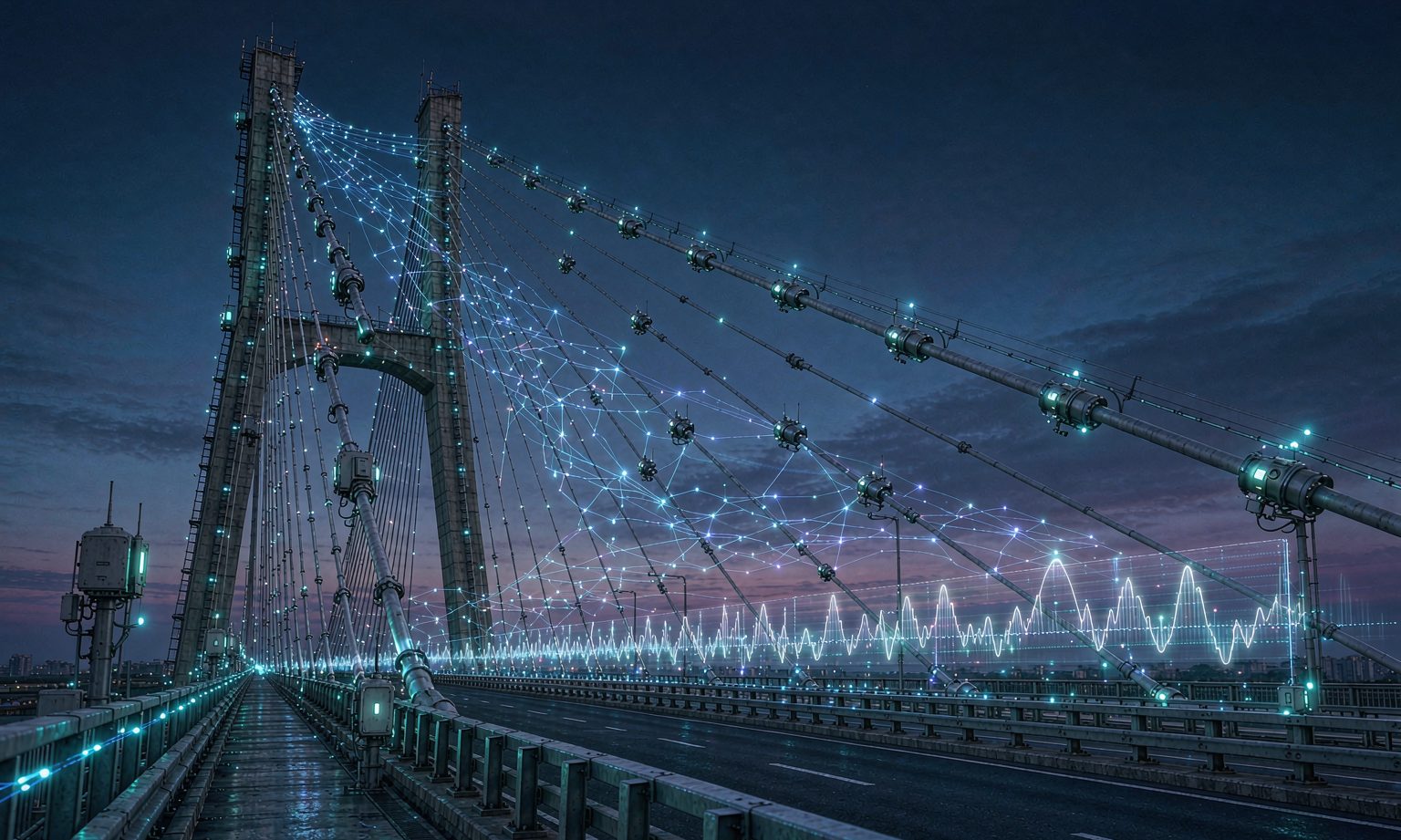
The Old Problem: Every Project Means "Teaching the System All Over Again"
The structural health monitoring industry has an unwritten rule: change the project, redo the algorithm.
Thresholds must be re-set — for the same mid-span vertical deflection, the normal fluctuation range of a cable-stayed bridge and a suspension bridge can differ by an order of magnitude. Features must be re-chosen — whether temperature acts as a covariate or a nuisance depends on the bridge type, orientation and local climate. Models must be re-trained — anomaly samples accumulated on one project are almost entirely useless on the next. Engineers who configure alarm logic jokingly describe themselves as "raising a new child for every bridge": after go-live, they tolerate false alarms for two or three months, label data by hand, tighten thresholds, and only then does the system gradually learn the ropes.
Statistics from a provincial bridge monitoring platform are telling: more than 300 bridges feed one platform, yet alarm rules are maintained per project, accumulating over 40,000 threshold entries; every year, 15% or more of these become stale due to environmental drift and sensor replacement, requiring dedicated staff to review them entry by entry. Most of an algorithm engineer's time goes into "move to a project, retune everything."
The root cause is that traditional anomaly detection is discriminative: it has only ever seen one class of bridge, one frequency band, so its generalization is inherently limited. Recent progress in time-series foundation models is rewriting that premise.
Time-Series Foundation Models: From "Model per Database" to "Use Out of the Box"
The idea behind time-series foundation models follows the same path as ChatGPT in text: first, large-scale pretraining on massive, heterogeneous generic time series teaches the model the "universal grammar" of temporal data — trends, seasonality, abrupt changes, superposed periodicities; on a specific task, instead of training from scratch, the model does zero-shot inference directly, or fine-tunes on only a small amount of target-domain data.
Between 2024 and 2026 this field converged on several representative models: Google's TimesFM (its second generation supports variable-length inputs and decoder-style forecasting), Amazon's Chronos (tokenizing numeric values and processing them with a language-model architecture), Salesforce's Moirai (supporting multivariate series and arbitrary sampling frequencies), plus industrially oriented models such as moment and UniTS. On public benchmarks, these models do zero-shot forecasting on unseen datasets with accuracy close to — and sometimes exceeding — specialized models trained from scratch on those datasets.
For the monitoring industry, the significance is not "a few points of accuracy" but a paradigm shift: the model's knowledge comes from the millions of generic time series seen during pretraining, not from labeled anomaly samples on one project. On a new bridge, the model is no longer a blank page but a general-purpose foundation that already knows what diurnal temperature cycles, traffic-load fluctuations and sensor drift look like — the project only needs to teach it this particular bridge's personality.
What It Can Actually Do in Structural Monitoring: Three Jobs
First: gap filling and outlier screening — automating data governance. Monitoring data is naturally incomplete: power interruptions, communication jitter and lightning-damaged channels leave holes in long sequences all the time. The traditional approach relies on interpolation and manual cleaning, with rules that can never be written exhaustively. A foundation model is fundamentally a probabilistic forecaster: given the segments before and after a gap, it outputs a completion distribution consistent with the bridge's habits, and flags values that "don't look like what this sensor would produce" as suspected anomalies. In practice, for hourly-mean series, completion error is typically within about 80% of expert manual interpolation — with close to zero workload.
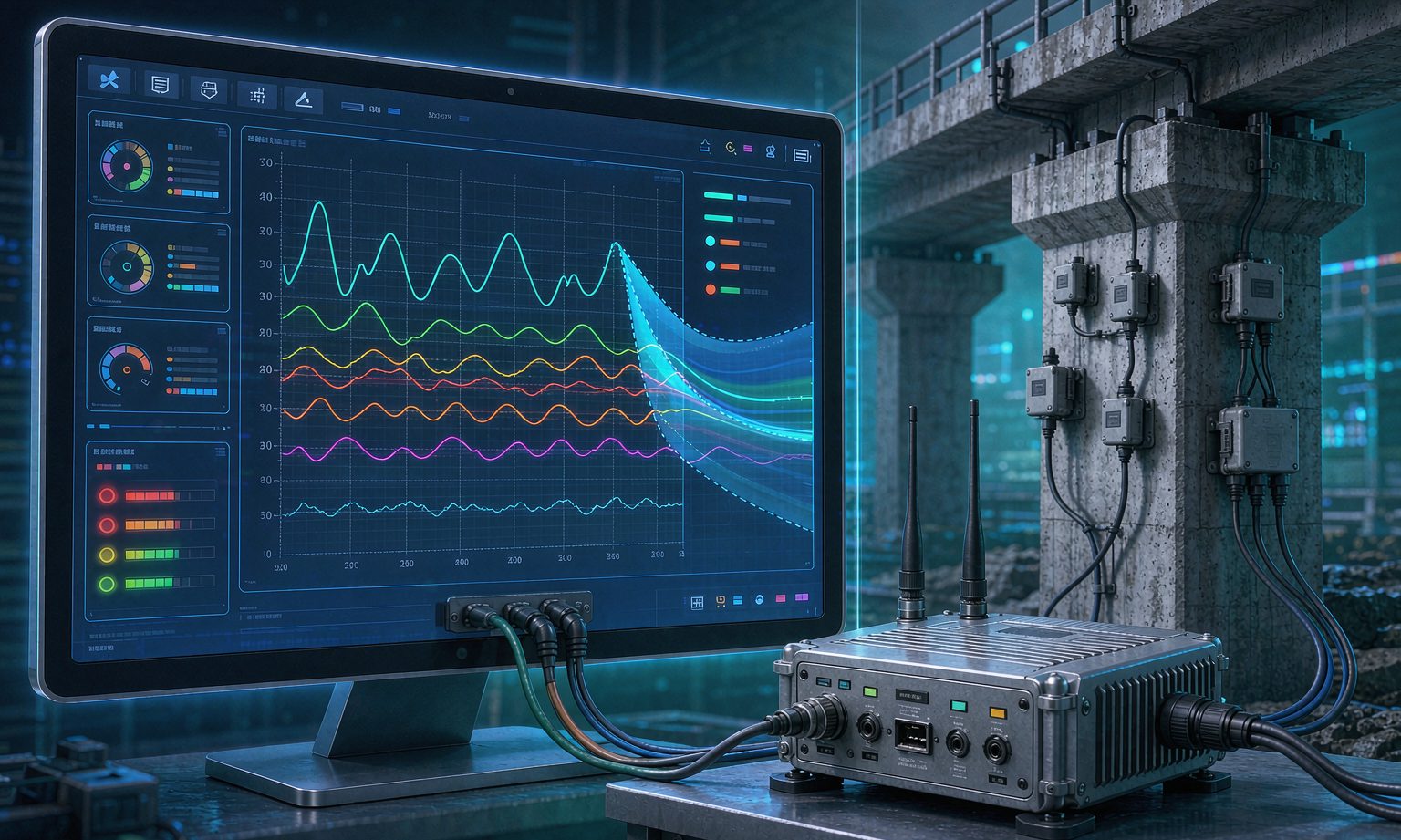
Second: forecast-based anomaly scoring to replace static thresholds. This is the most promising use. The model continuously outputs a prediction interval for "what the next value should be," and observations outside the interval accumulate an anomaly score. The essential difference from a static threshold is context awareness: a deflection of 80 mm on a summer afternoon may be a normal thermal effect, while the same value at dawn in early winter deserves attention — no conventional threshold rule can express that kind of contextual sensitivity, but a foundation model has it built in. Early industry practice shows this approach can cut false alarms by half or more on deflection and tilt channels dominated by traffic load, without missing genuine trend anomalies.
Third: trend extrapolation — from "alarm" toward "early warning." Extending the model's prediction interval to daily and weekly horizons lets operators watch for sustained divergence between measurements and the forecast trajectory. When residuals drift one-sided for many consecutive days, it often indicates slow-developing defects such as bearing seizure, accelerated creep or foundation settlement. This "forecast-style" criterion does not attempt precise diagnosis; it buys the maintenance team a time window — typically weeks ahead of the moment a threshold alarm would have fired.
A Real Ledger from a Bridge Cluster
Starting in 2025, a coastal city introduced time-series foundation models into its centralized monitoring platform covering 47 in-service bridges, producing a reference deployment:
- Deployment form: centralized inference at the platform. About 21,000 sensing channels across the 47 bridges stream minute-level data into the platform, where the foundation model, running in batches, produces rolling forecasts and anomaly scores for every channel; a single consumer-grade GPU (24 GB VRAM), after quantization, supports daily inference for the full channel set;
- Cold-start speed: new bridges no longer need a two-to-three-month tuning honeymoon. Zero-shot anomaly scores, plus two weeks of fine-tuning on target data, reach the stability that manual tuning used to achieve after three months — the period from bridge onboarding to trustworthy alarms shrank from roughly 90 days to under 20;
- False-alarm control: piloted on deflection, tilt and cable-force channels, running in parallel with the legacy static-threshold system for 6 months, the foundation-model route produced about 40% of the legacy daily false-alarm volume, with no missed events on the pilot channels;
- Cost structure: platform-side investment was mainly two GPU servers plus one algorithm engineer's maintenance hours; spread over 47 bridges, the annual per-bridge cost is less than one tenth of the traditional outsourced "custom algorithm per project" fee.
The key to this ledger is the economies of scale: under the traditional model, algorithm cost grows linearly with the number of bridges; under the foundation-model model, what grows is mainly inference compute, giving a visibly flatter marginal-cost curve. The more bridges, the better the deal.
The Hard Walls: Domain Gap, High-Frequency Data and Edge Compute
Presenting this technology as a cure-all would be irresponsible. There are three walls in deployment — people have crossed them, but not easily.
The domain gap is the first wall. Pretraining corpora are dominated by generic series from finance, energy and transport; structural monitoring data has its own temperament — strong temperature covariates, tidal periodicity, the impulsive structure of vehicle loads — none of which dominates generic corpora. Zero-shot performance that dazzles on generic data usually degrades on structural data, so the pragmatic route is "zero-shot as the floor + target-domain fine-tuning"; projects that skip fine-tuning entirely are still rare.
High-frequency data is the second wall. Foundation models are natively good at second-to-hour low/mid-frequency series, while dynamic strain and acceleration channels run at hundreds or thousands of hertz. Feeding raw high-frequency streams is unrealistic; the industry answer is a two-tier architecture: the edge extracts features (RMS, peaks, band energies), downsampling high-frequency signals into minute-level feature series before they enter the foundation model. Fine-grained damage identification on high-frequency channels remains, for now, the territory of classical signal processing and specialized models.
Edge compute is the third wall. Centralized inference at the platform has no compute barrier, but many scenarios demand "judgment even when offline" — communication backhaul for tunnels and mountain bridges is not always reliable. Squeezing a quantized foundation model into an edge gateway is becoming feasible: a 4-bit-quantized small time-series model already runs second-level inference on industrial gateways with NPUs, but multi-channel concurrency, model-update distribution, and consistency calibration between edge and cloud scores remain delicate engineering work.
A Checklist for Deciding Whether to Adopt
Drawing on existing projects, five points to watch when evaluating time-series foundation models:
- Look at scale first. For owners with fewer than ten bridges, well-tuned thresholds plus a rules engine may suffice; the scale effect only emerges on centralized platforms with dozens of bridges or more.
- Fix data quality first. However well the model fills gaps, it cannot fill chronically missing or clock-misaligned data. Push acquisition completeness above 95% before talking intelligence.
- Keep a dual-track architecture. Run foundation-model scores in parallel with existing static thresholds for at least one flood season and one full winter-summer cycle, and let real false/missed alarm data set the cutover pace — no "big bang" switches.
- Explainability must keep up. What maintenance staff see should not be a bare score, but evidence they can visually verify, such as the divergence chart between the prediction interval and the measurement — otherwise alarms will never be trusted.
- Be clear about what it does not do. Load-capacity assessment and damage localization, which require mechanical reasoning, still belong to traditional FEM and specialized methods; the foundation model is a sense amplifier, not a replacement for the diagnosing engineer.
Summary
What time-series foundation models fundamentally change is the economics: algorithm cost shifts from "linear, repeated investment" to "pretrain once, reuse everywhere at low marginal cost." Gap filling, threshold replacement and trend extrapolation are already proven in the field, and measured results — false alarms cut by half, cold-start shortened by more than 70% — justify serious evaluation for any mid-sized or larger platform.
But it is not a silver bullet: high-frequency channels and fine-grained diagnosis remain in the hands of traditional methods, and edge deployment and explainability are engineering problems that demand sustained investment. Two things to watch over the next two or three years: first, whether the industry builds its own pretraining corpus — whoever first assembles large-scale labeled data across bridge types and regions will own the next generation of platforms; second, the fusion of foundation models with physics-based models, letting statistical forecasts and mechanical constraints check each other. For this industry, the era of "raising a new child for every bridge" may truly have started counting down.