
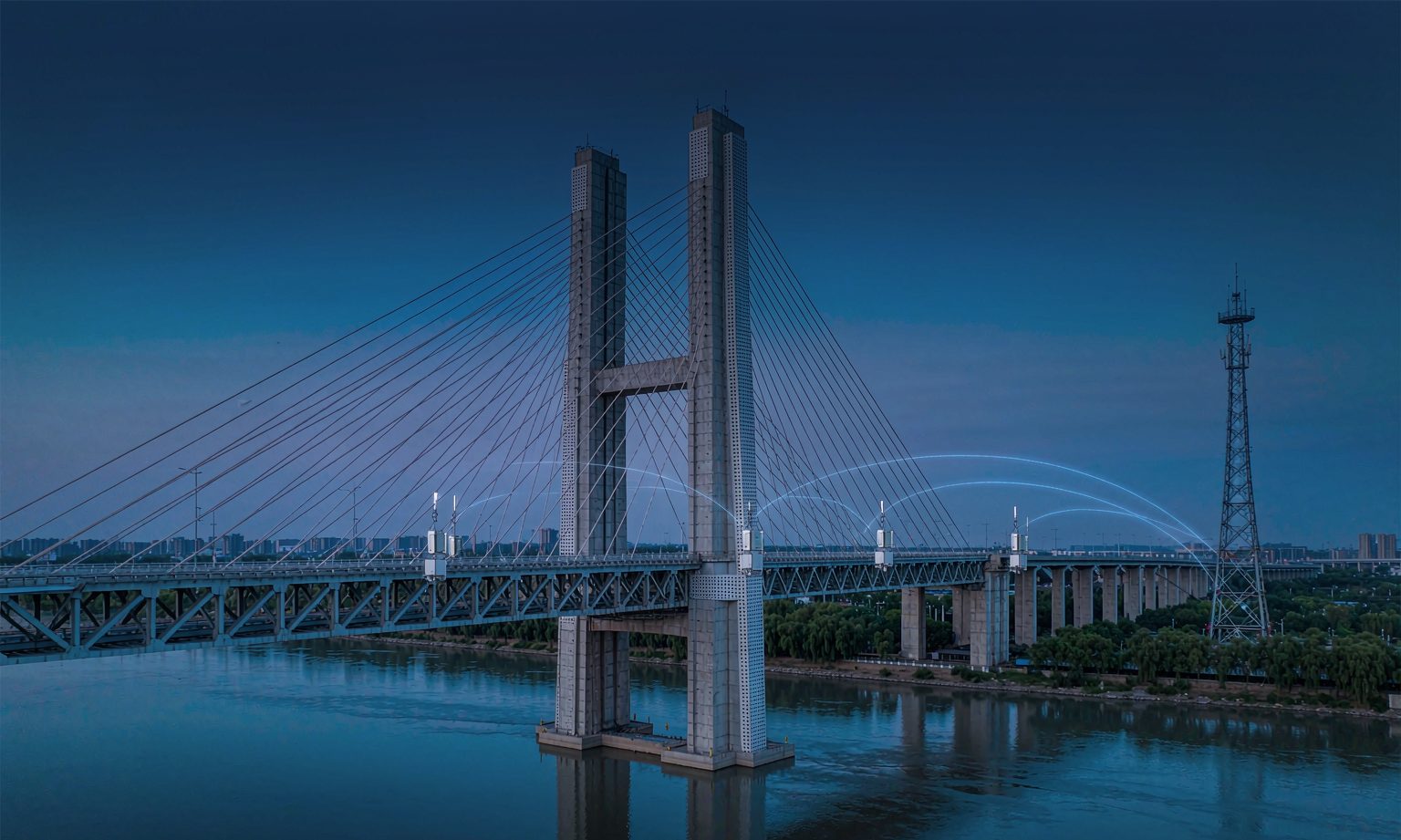
1. Structural Monitoring Terminals Are Stuck Between "Cannot Connect" and "Cannot Transmit"
A medium-sized bridge with full-element online monitoring easily involves a hundred or more measurement points: strain gauges, accelerometers, cable-force sensors, GNSS, temperature and humidity sensors — all of which must send data back to the platform. For years the mainstream answer for connectivity has been 4G Cat.1 and NB-IoT, but both roads hit ceilings.
NB-IoT is cheap (modules at a dozen-odd yuan) and power-efficient (a single battery lasts years), but its speed is only tens of kbps — enough for low-frequency static quantities such as a few daily temperature, humidity and displacement summaries. Yet once an accelerometer samples continuously above 100 Hz, that is tens of megabytes per day, which NB-IoT simply cannot transmit. Cat.1 delivers the speed (roughly 5 Mbps uplink), but it belongs to the 4G ecosystem: as 2G/3G networks are sunset and operators shift resources toward 5G, long-term investment in 4G evolution is shrinking. More critically, the two trump cards of the 5G era — network slicing and 5G LAN — are both beyond Cat.1's reach.
At the other end, traditional 5G eMBB modules are excellent in every respect except price: module costs long hovered around 1,000 yuan. For bridge and tunnel projects with hundreds of measurement points, connectivity cost alone punches through the budget. Structural monitoring terminals have long been stuck in this gap between two unsuitable options.
2. RedCap: Subtracting from 5G
RedCap (Reduced Capability, a class of 5G terminals with reduced capabilities) is the answer 3GPP delivered in Release 17 (frozen in 2022). The idea is blunt: strip away every capability that eMBB-class terminals use and mid-speed IoT does not actually need.
The subtraction list is clear: bandwidth is cut from 100 MHz to 20 MHz; receive antennas are reduced from four to one or two, halving the RF channels or more; and enhancement features such as carrier aggregation are dropped. The result: peak rates of roughly 150 Mbps downlink and 50 Mbps uplink — an order of magnitude above Cat.1 yet far below eMBB's gigabit class. Release 18 went further with eRedCap, pushing peak rates down to the 10 Mbps class and costs lower still, putting it in direct competition with Cat.1. Meanwhile RedCap inherits 5G's key foundations: network slicing, 5G LAN, the uRLLC low-latency evolution path, and eDRX/PSM power-saving mechanisms — giving battery-powered terminals a standards-based standby strategy.
In one sentence: RedCap is "the Cat.1 inside 5G" — a mid-speed tier that catches the massive wave of mid-speed IoT terminals migrating from 4G to 5G.
3. The Price Curve: From the 1,000-Yuan Level to 200-300 Yuan in Two Years
What decides whether a connectivity technology scales is never the standards document but the module price curve — and RedCap's curve is steep:
- In 2023, the first commercial year, initial RedCap modules were generally quoted around 1,000 yuan;
- In 2024, as domestic chipmakers (UNISOC, ASR Microelectronics and others) mass-produced RedCap chips and multiple module vendors followed, mainstream quotes quickly fell below 500 yuan;
- Since 2025, volume pricing for leading vendors' RedCap modules has landed in the 200-300 yuan range, with some industry procurement projects quoting even lower; the industry widely expects prices to converge further toward Cat.1 as R18 eRedCap chips ship.
The network side is moving just as fast. The notice on advancing 5G lightweight (RedCap) technology evolution and application innovation issued by the Ministry of Industry and Information Technology in 2023 explicitly set the goal of continuous RedCap coverage in county-level and above urban areas by 2025. The three major operators have deployed densely since 2024, and RedCap base stations nationwide have already reached a scale of hundreds of thousands of sites, prioritizing urban areas, transport corridors, and industry private-network demand zones such as power and security. Both GSMA and domestic research institutes forecast that RedCap will become one of the main tiers of new cellular IoT connections in 2025-2027.
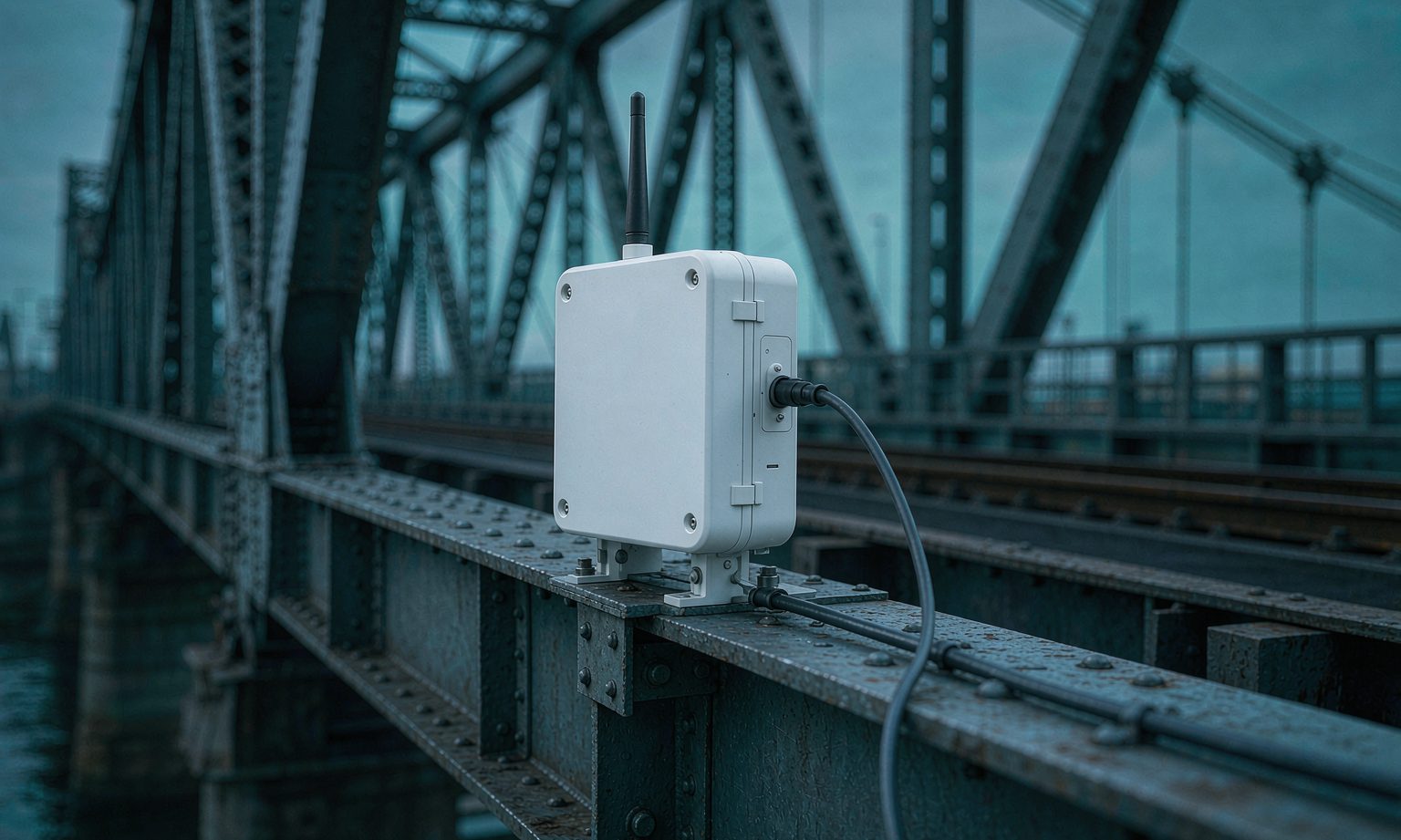
4. Deployment Paths for Bridges and Tunnels
For the structural monitoring industry, RedCap's value is not "one more module to choose from" — it opens three roads that were previously impassable.
First, high-frequency vibration data goes straight to the cloud. Cable vibration, modal identification and vessel-collision events all demand synchronized sampling above 100 Hz, with per-point daily data volumes in the tens of megabytes. With 50 Mbps uplink, acceleration channels no longer need heavy compression or decimation at the edge; raw waveforms can go straight back to the platform for fine-grained analysis — a real, tangible gain in modal frequency identification accuracy.
Second, 5G LAN brings the "site-area network" into the terminal. Structural monitoring sites typically follow a "many sensors + edge acquisition gateway" architecture. With 5G LAN support, sensor terminals on the pylon and the acquisition gateway inside the box girder can form a carrier-side virtual LAN: data loops locally and exits through the gateway, eliminating field switches and fiber runs — especially friendly to tunnels, where cabling costs are extremely high.
Third, slicing reserves a slot for "private-network experience." Many owners demand independence and latency guarantees for monitoring data. Network slicing, previously discussed only for eMBB private networks, is equally accessible to RedCap terminals; combined with operators' 5G virtual private network offerings, the monitoring data stream can be isolated from ordinary office traffic, ensuring stable backhaul during acquisition peaks. The power industry has gone first: RedCap power private-network pilots for distribution differential protection and transmission-line online monitoring are already running in multiple provinces, and their networking models offer a direct reference for the transport sector.
5. Division of Labor with NB-IoT and Cat.1 — Not a Replacement
RedCap deployments are always asked one question: "Does this kill NB-IoT and Cat.1?" The answer is no — the three are a division of labor:
| Dimension | NB-IoT | LTE Cat.1 | RedCap (R17) |
|---|---|---|---|
| Peak rate (uplink) | ~60 kbps | ~5 Mbps | ~50 Mbps |
| Module price | ~a dozen yuan | 20-40 yuan | 200-300 yuan |
| Power draw | Ultra-low, battery lasts years | Medium, mostly externally powered | Medium-low, supports eDRX/PSM |
| 5G slicing / 5G LAN | No | No | Supported |
| Typical scenarios | Low-frequency static quantities, metering | Mid/low-frequency acquisition, location backhaul | High-frequency vibration, video, private-network LAN |
The logic is clear: static quantities stay on NB-IoT — cheap and abundant; for mid/low-frequency acquisition Cat.1 remains the cost optimum; and only when high-frequency synchronized vibration, on-site LAN networking or slice-based isolation is involved does RedCap become the only option today that offers "5G capability at an IoT price." The selection question shifts from "should we adopt 5G" to "which measurement points deserve RedCap."
6. Three Engineering Hurdles
First: coverage blind spots. RedCap base stations are prioritized for urban areas and trunk corridors, while bridges and tunnels are overwhelmingly located in mountain valleys and river suburbs. Field strength must be measured station by station before deployment; weak-coverage points either wait out the operator's densification cycle or fall back to a dual-mode design — dual-mode redundancy (automatic RedCap + Cat.1 switchover) is currently the safe approach for mountain projects, at the cost of slightly higher module prices.
Second: ecosystem maturity. The RedCap terminal supply chain is still climbing: some modules' measured eDRX power draw deviates from datasheet figures, and compatibility issues in certain chip batches require firmware iterations. Before volume procurement, run a pilot batch of 20-50 units to validate power consumption, reconnection behavior and roaming performance, then scale up.
Third: tariff structure. RedCap plans have not yet reached NB-IoT's level of price competition, and some provincial operators tier industry tariffs by data volume — not entirely friendly to "many points, tiny flows, always-on" monitoring terminals. In project budgeting, compute the five-year connectivity tariff together with the module price premium, and give priority to operators' industry bundle plans.
7. A Deployment Checklist
If you are evaluating RedCap for a bridge-and-tunnel monitoring project, proceed in five steps:
- Tier the connectivity by measurement point. Static quantities on NB-IoT, mid/low frequencies on Cat.1, and RedCap for high-frequency vibration, video and networking requirements — no one-size-fits-all.
- Coverage first. Measure field strength point by point with a test terminal; for weak-coverage locations, engage the operator on densification early and reserve time for it in the schedule.
- Dual-mode fallback. For mountain and tunnel projects, choose RedCap + Cat.1 dual-mode terminals with automatic fallback on network anomalies to avoid single-link risk.
- Pilot before scaling. Validate power, reconnection and tariffs with an initial batch of 20-50 units before volume deployment; write the measured results into procurement technical requirements.
- Actually use 5G LAN and slicing. Form a 5G LAN between the acquisition gateway and sensor terminals, and route the monitoring stream through an isolated slice — this is where RedCap's real premium over Cat.1 lies.
8. Summary
RedCap solves a concrete and widespread pain point of the structural monitoring industry: in the middle ground where NB-IoT cannot transmit and eMBB is unaffordable, there is finally a connectivity option with both a 5G capability foundation and an IoT-grade price curve. Module prices of 200-300 yuan, network coverage at the scale of hundreds of thousands of sites, and the networking power of slicing and 5G LAN push capabilities once reserved for flagship projects — direct high-frequency vibration backhaul, virtual site-area networking, private-network-grade isolation — down to every routine monitoring project.
But the boundaries are real: it does not replace NB-IoT's extreme low power, and in the short term it cannot match Cat.1's price. Mountain coverage, ecosystem maturity and tariff structure — these three hurdles set each project's actual deployment rhythm. Over the next two to three years, two things deserve watching: whether eRedCap chip shipments push prices close enough to Cat.1 to make "dual-mode redundancy" a standard design, and whether operator industry tariffs deliver a tier genuinely matched to massive low-volume monitoring terminals. Once these land, "choosing 5G per measurement point as needed" will become as routine a design step in structural monitoring as "choosing battery versus external power per point."