
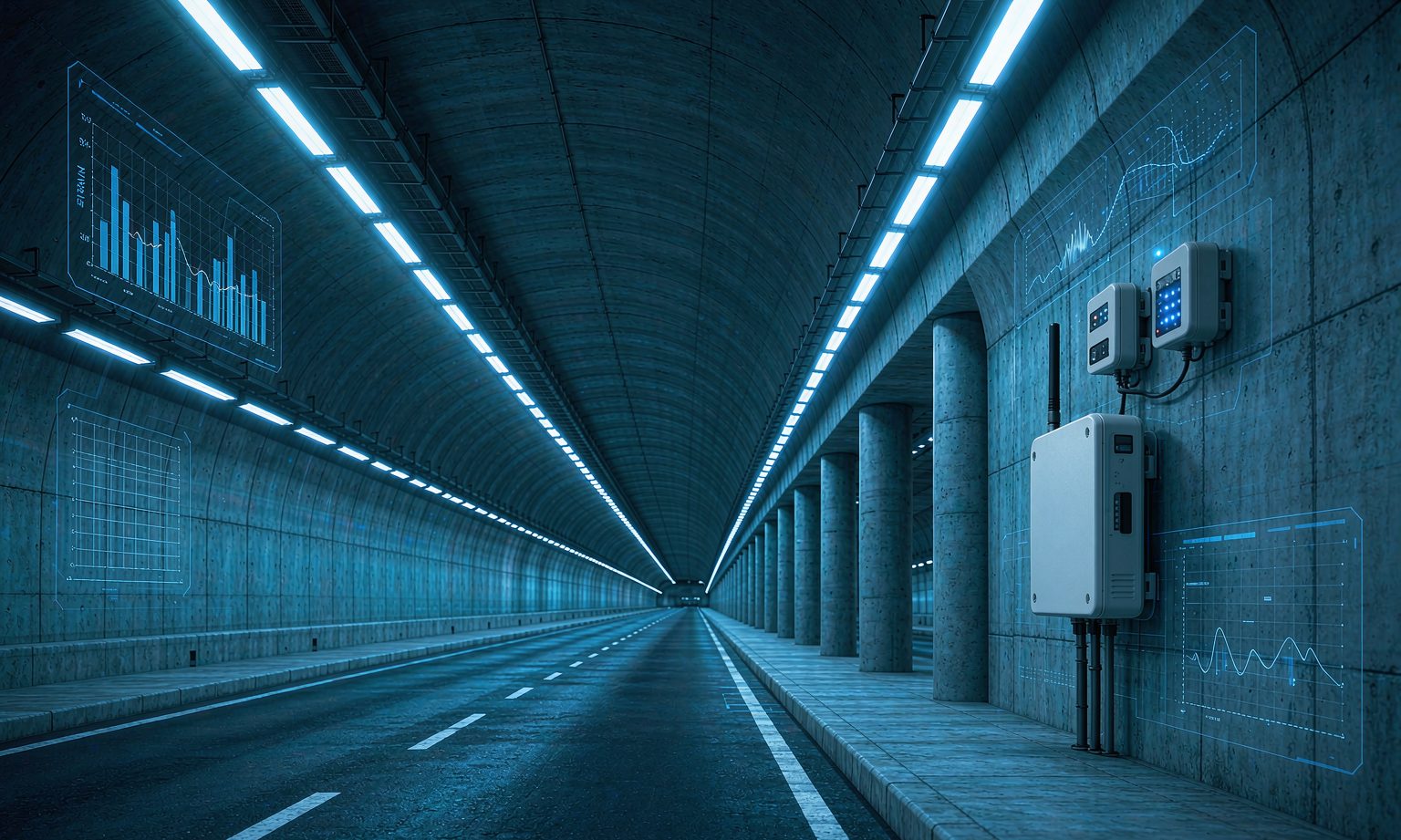
1. Why Tunnels Are the Hardest Place to "Check Up On"
In the structural monitoring industry, tunnels are universally recognized as the "difficult case." The same sensor package that runs smoothly on a bridge often struggles inside a tunnel, for four reasons.
Harsh environment. Relative humidity inside a tunnel stays above 85% year-round, and the piston wind from passing traffic brings sharp temperature and humidity swings plus dust, so electronic equipment fails noticeably more often than outdoors. Statistics from one province's group of in-service tunnels show that the annual equipment failure rate inside tunnels is roughly 2–3 times that of comparable bridge installations, with connector oxidation and condensation-induced short circuits accounting for more than half of all faults.
Restricted power and cabling. An operating tunnel cannot have its walls channeled and rewired on a large scale for a monitoring system — surface-mounted cables interfere with interior finishes and fail fire acceptance, while embedded wiring risks damaging the lining's waterproofing. Power is an even harder constraint: the nearest supply point is often hundreds of meters away from many sections.
Communication dead zones. Deep inside a tunnel there is no satellite signal, and public cellular coverage is intermittent; between two cross-passages there can be more than a kilometer of "signal depression."
Manual inspection only sees the surface. Under China's Highway Tunnel Maintenance Technical Specification (JTG H12), routine patrols run on a daily cycle and periodic inspections on a yearly cycle — but an inspection vehicle driving through only sees the lining's "appearance": traces of water seepage and the pattern of cracks. "Internal medicine" problems behind the lining — voids, rebar corrosion — are entirely invisible to the naked eye.
These four constraints dictate that tunnel monitoring must take the "low-power, wireless, minimal-cabling" route — which happens to be the fastest-advancing direction in IoT over the past few years.
2. Wireless Sensor Networks: Power and Cabling Are No Longer the Roadblock
Three families of devices star in tunnel wireless monitoring: MEMS tiltmeters, vibrating-wire crack gauges (paired with wireless acquisition terminals), and environmental sensors (temperature/humidity, pore pressure, wind speed).
Power budget is the first design metric. A typical wireless MEMS tiltmeter draws microamps on standby; waking once per hour with a 2-second measure-and-transmit cycle, two ER34615 lithium-thionyl-chloride cells can support more than 5 years of operation. Raise the sampling rate to per-minute, add local caching and retransmission, and lifetime shrinks to 2–3 years — so "how densely to sample" is not a technical question but a battery-budget question. The engineering compromise is a tiered strategy: one measurement every 15 minutes in normal sections, automatically switching to second-level dense sampling under triggered conditions such as earthquakes or heavy rain.
Radio propagation inside a tunnel needs dedicated design. LoRa can reach several kilometers in the open, but inside an arched lining with frequent traffic, multipath reflection and vehicle blocking compress the real communication range to a few hundred meters. The mature approach places gateways at cross-passage entrances and portal machine rooms, hops longitudinally every 500–800 meters, and adds repeaters where necessary. NB-IoT depends on operators' deep coverage inside the tunnel, so a test terminal must verify field strength on site before selection — this step cannot be skipped. The lesson of "coverage on the map, no signal in the tunnel" is not rare.
Installation must be "light." The entire site work for a wireless node is two expansion bolts and one anti-tamper label; a single point installs in under 20 minutes, with no hot work and no wall channeling, facing an order of magnitude less resistance at fire acceptance and operations approval than wired solutions. A 2-kilometer tunnel section can have more than a hundred measurement points deployed by two or three workers in a week.
3. AI Vision: A "Radiologist" for Seepage and Cracks
The two highest-frequency tunnel defects — water seepage and lining cracks — are exactly the ones best suited to visual recognition.
An inspection vehicle carrying industrial cameras travels the tunnel at 30–40 km/h; with a supplementary lighting system it captures lining-surface imagery at millimeter-level resolution.
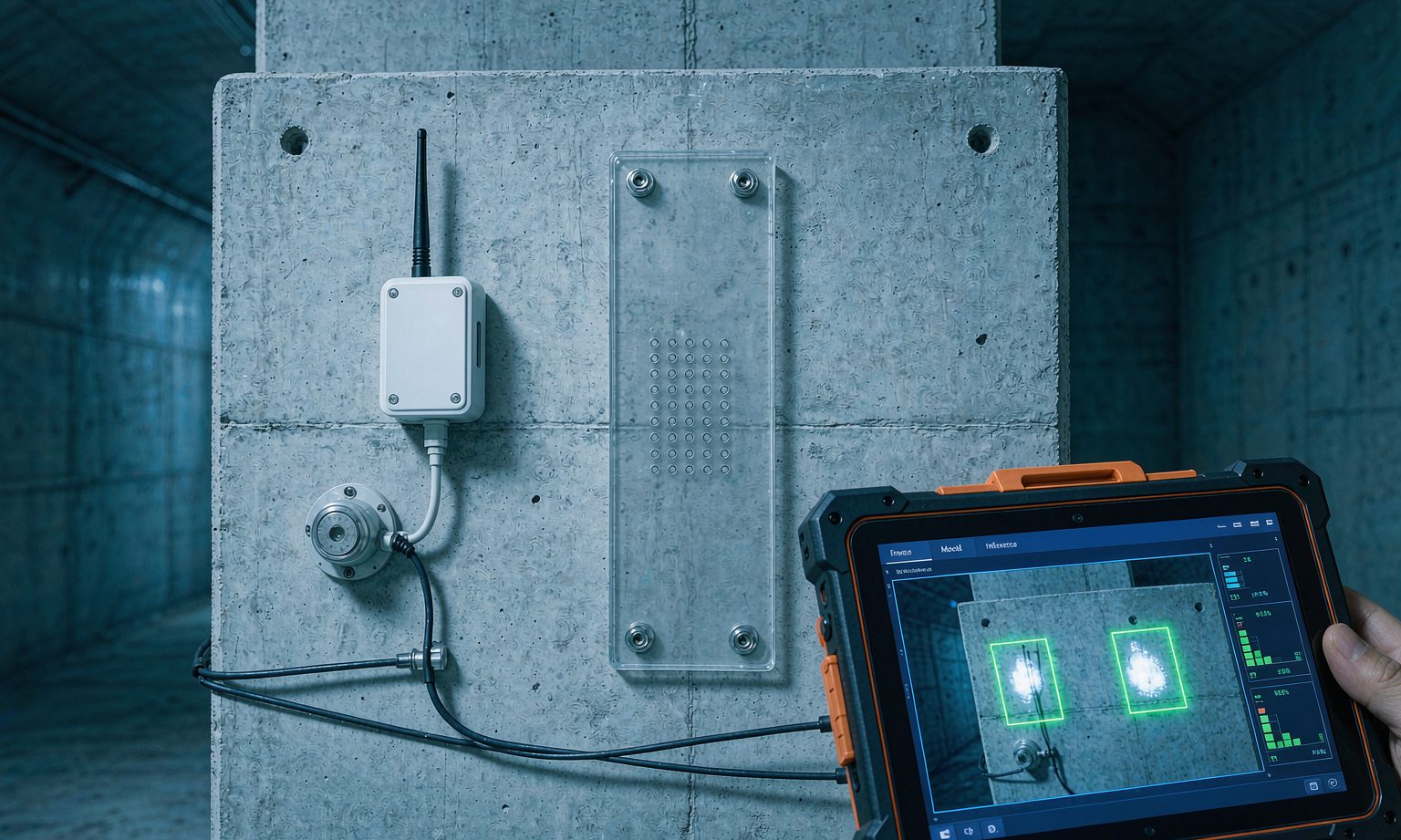
The AI model does three things with this data stream: first, seepage detection, classifying damp patches, dripping and gushing water, and grading them by area and trend; second, crack identification and quantification, outputting each crack's length, width and orientation, and registering it against historical images to judge whether it is stable or propagating; third, change tracking, building an archive of each location's defects keyed to chainage, with automatic comparison on the next inspection pass so that only increments are pushed to human reviewers.
Industry field data can be benchmarked roughly as follows: seepage recognition accuracy is commonly above 90%, and crack width measurement error is controllable within 0.2–0.5 mm — already at or beyond the level of trained human eyes, and machines neither fatigue, nor fear darkness, nor lose their records. After one province's expressway tunnel group connected AI visual inspection into its maintenance system, the cycle from defect discovery to a raised work order dropped from an average of two weeks to within 48 hours.
Vision and wireless sensing do not replace each other — they divide the labor: vision handles "what is happening on the surface," the sensor network handles "how the structure is moving inside." Seepage belongs to vision, but the slow evolution of voids behind the lining and the gradual trend of convergence deformation require continuous observation by fixed tiltmeters and convergence gauges. Only when the two data streams are fused at the platform layer can the system answer "how serious is this defect, and does it need immediate action?"
4. Data Fusion: Environmental Quantities Are the "Translator" for Structural Quantities
The most common pitfall in tunnel monitoring data is treating structural response directly as structural condition. Thermal expansion and contraction of the lining concrete can produce seasonal fluctuation in surface strain an order of magnitude larger than real structural change; traffic loads superimpose periodic components on tilt and vibration data.
The platform-layer solution treats environmental quantities as the "translator": build a baseline model with temperature and traffic flow as covariates, subtract the environment-induced normal fluctuation from structural data first, and only feed the residual into the alerting logic. After one operating tunnel deployed its temperature-compensation model, seasonal drift false alarms at tilt points fell by about 80%, and alert thresholds could simultaneously be tightened by 30% — improving sensitivity. This "explain first, then alarm" logic costs little, yet it decides whether O&M staff trust the alerts or simply switch off the push notifications.
5. A Real Ledger from a Tunnel Group
A comprehensive monitoring project covering six in-service tunnels in a prefecture-level city (about 18 km of single-bore total length) shows how the numbers work out:
- Sensing layer: 240 wireless tiltmeters, 120 crack gauges, and 180 pore-pressure and temperature/humidity points — 540 wireless measurement points in total, at a per-point all-in cost (including battery and installation) in the hundreds of yuan;
- Network layer: 24 LoRa gateways placed at cross-passage entrances and portal machine rooms, all data aggregated and uplinked through the portal machine rooms, with monthly traffic cost negligible;
- Vision layer: 2 rail-mounted inspection vehicles completing one full-coverage inspection round of all tunnels per month;
- Platform layer: an AI recognition and threshold-alerting cloud platform, integrated with the municipal maintenance work-order system.
The total initial investment was about 40% of a conventional wired monitoring scheme, with no recurring need to replace power cabling or maintain communication links. In its first year of operation, cases caught early by the system included: an expanding void behind the lining (captured by the residual sequence of a tiltmeter) and an abnormal post-rainy-season increase in seepage volume (found by visual archive comparison) — both treated before they degraded to visible severity.
6. A Practical Selection Checklist
Drawing on multiple projects, five points deserve attention when evaluating a tunnel monitoring scheme:
- Test field strength on site before choosing the network. Before picking between LoRa and NB-IoT, verify communication quality with real terminals at the tunnel's deepest point and the farthest cross-passage — do not trust the coverage map.
- The battery budget defines the sampling strategy. Put "how dense, how much to transmit, how long to store, how many years of life" into one table and settle it explicitly, to avoid a fleet-wide battery swap one year after launch.
- Visual inspection must close the loop into maintenance work orders. If AI recognition results cannot automatically generate a chainage-keyed defect archive and work orders, the value is halved.
- The environmental compensation model must exist from day one. Subtracting temperature and traffic baselines is not a "phase-two optimization" — it is a capability the first platform release should deliver.
- Choose ingress protection by the tunnel's real environment. Start at IP67 for node devices, fully pot all connectors; in southern tunnels, condensation is deadlier than dust.
7. Summary
The real bottleneck of tunnel monitoring was never "lacking a good sensor" — it is the four engineering constraints of power, cabling, communication, and manpower. Low-power wireless sensor networks solve "measure it," AI vision solves "see it clearly," and environmental compensation with data fusion solves "alarm accurately." Combined, they bring the structural health-check cost of an ordinary tunnel down to a fraction of a flagship project's, making "monitoring for every tunnel" feasible for the first time.
The next stage has two things to watch: first, whether multimodal lining-defect data (vision + sensing + historical maintenance records) can train genuine risk-prediction models, advancing from "discovering defects" to "predicting defects"; and second, centralized operation of tunnel groups — when six tunnels' data converge onto one platform, maintenance resource dispatch shifts from "patrol on schedule" to "repair by risk." For the monitoring industry, the wireless retrofit of tunnels may be one of the largest incremental markets of the next five years.