
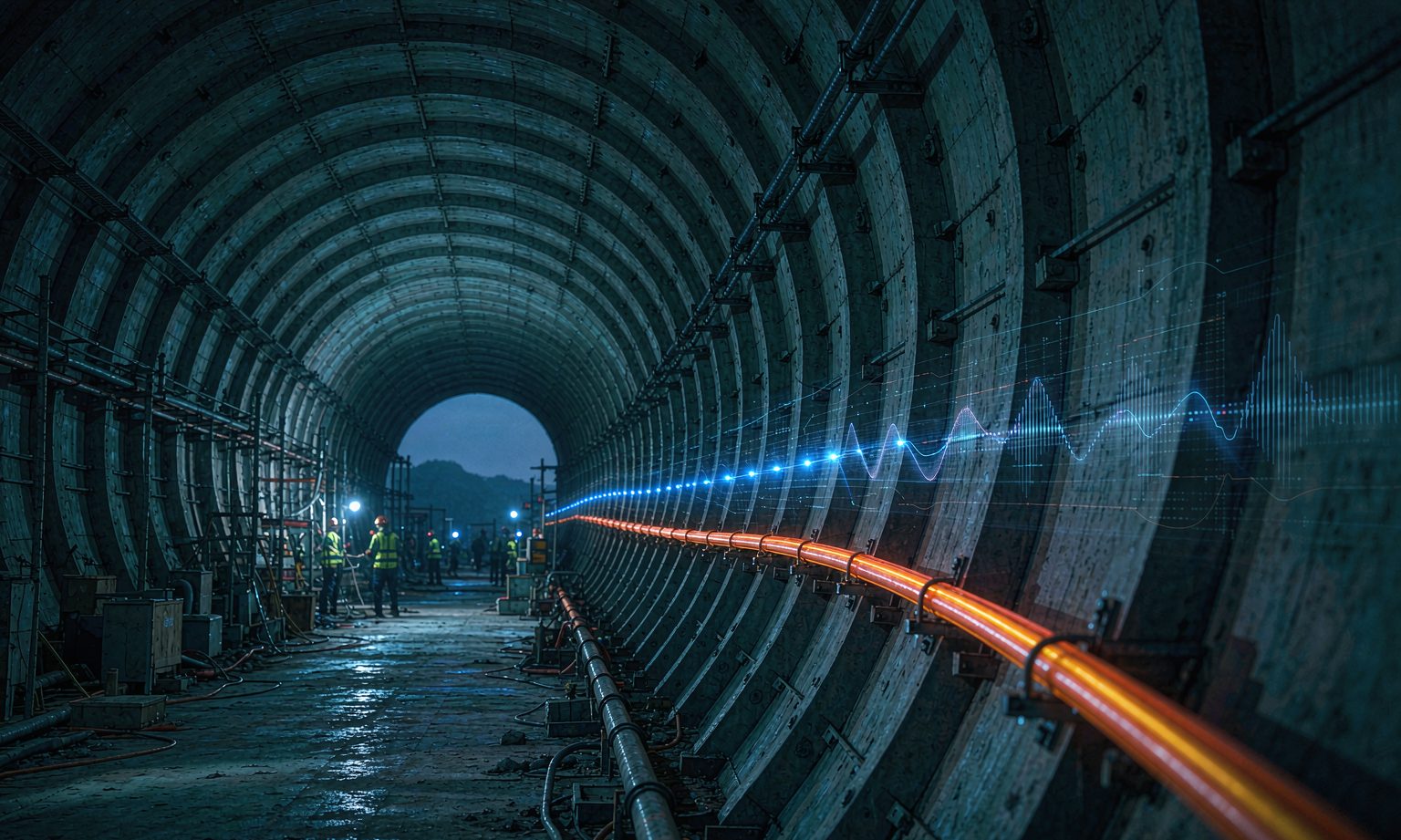
I. The Most Expensive Sensors Are Often Already in the Ground
There is a counter-intuitive truth in the structural monitoring industry: what a city lacks most is not sensors, but trenches in which to place them.
Take oil and gas pipelines. Since 2023, the investigation reports of multiple domestic pipeline incidents have pointed to the same cause — third-party construction damage. Along a pipeline corridor of dozens to over a hundred kilometers, a human patrol covering the full route once a day and night is already the limit, while an excavator can go from touching soil to rupturing the pipe in as little as a dozen minutes or so. The traditional fix is to install supplemental vibration and displacement sensors along the route, but every measurement point needs power, communications, lightning protection and maintenance; the cost runs to tens of thousands of yuan per kilometer, and simply cannot be scaled across a long transmission pipeline.
Yet the answer has been lying in the cable trench next to the pipeline all along: the communication cable laid alongside the pipe is underground all year round, sharing the trench or running adjacent to it. What DAS (Distributed Acoustic Sensing) does is turn this "data-transmitting line" into a "sensing line" at the same time — an interrogator mounted at one end of the cable injects coherent light pulses into the fiber, and the backscattered Rayleigh signal carries strain information from every meter along the route. One cable is equivalent to thousands of virtual measurement points over a 50 km sensing length, spaced a few to a dozen meters apart, without digging a single new trench.
The field has clearly heated up over the past two years: several pipeline operators have made DAS a standard tool for third-party damage prevention, and some telecom operators have begun studying how to reuse existing metropolitan fiber as an "urban sensing nerve", piloting it for road traffic flow, ground subsidence and perimeter security. The industry logic has changed — sensors are no longer purchased one by one; they "grow" out of existing infrastructure.
II. The Principle: φ-OTDR, Giving Fiber Its Ears
The physical foundation of DAS is phase-sensitive optical time-domain reflectometry (φ-OTDR). A narrow-linewidth laser in the interrogator injects highly coherent light pulses into the fiber. As the pulses propagate, they continuously generate Rayleigh backscatter, which returns along the original path and is received. When vibration or strain occurs near the fiber, the refractive index and length of that small segment of fiber change minutely, shifting the phase of the backscattered light.
The key is "phase demodulation": the interrogator continuously samples the returning scattered signal at MHz-class rates, differentiates the scattering traces from successive pulses, solves for the phase variation along the fiber, and converts it into strain rate or vibration intensity. Because each scattering location corresponds to a round-trip time, the time difference precisely locates where along the cable the disturbance occurred — that is what "distributed" means: not one sensor, but a continuously distributed array of measurement points along the entire fiber.
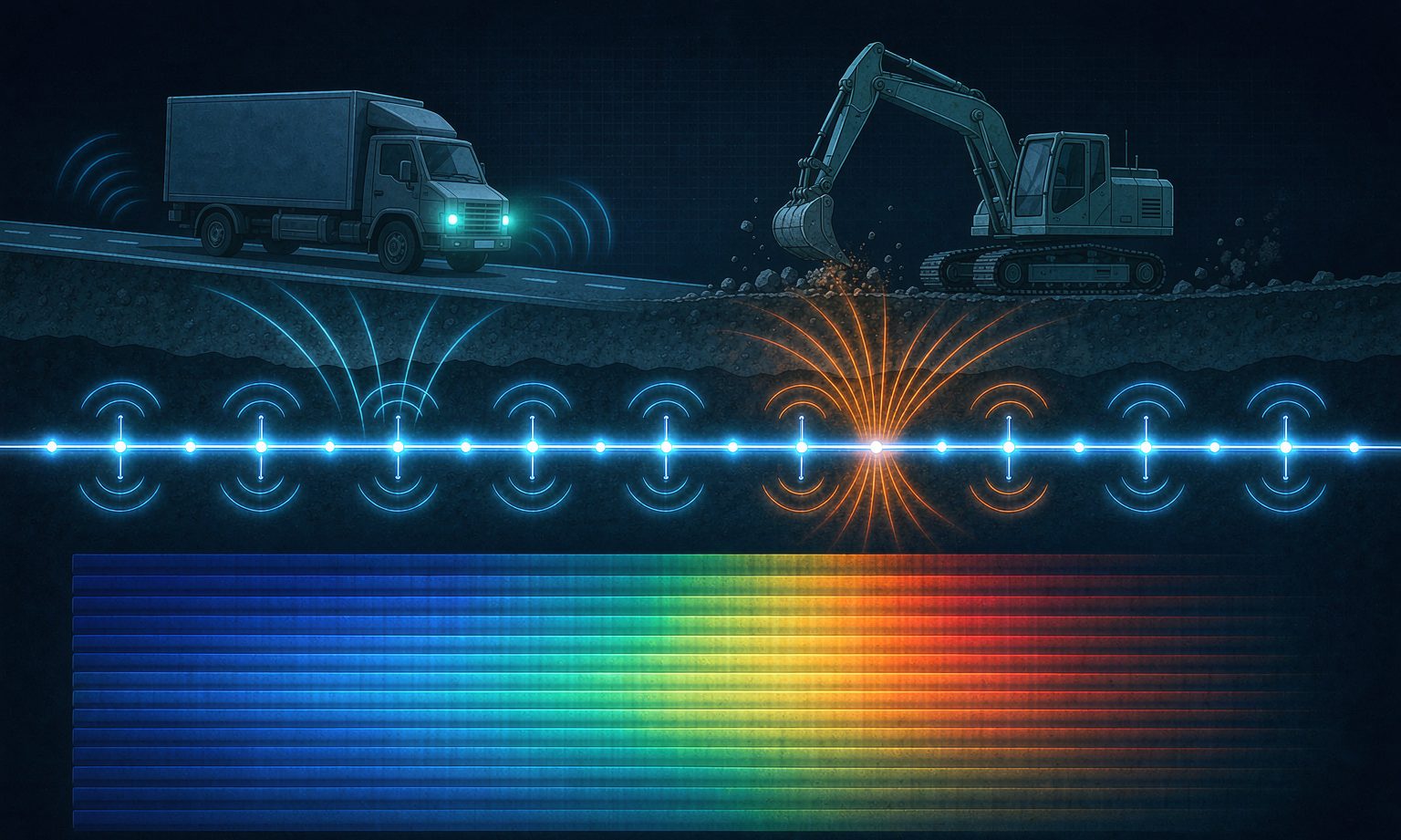
An analogy: a conventional sensor is "a voice recorder placed at a critical location", while DAS is "an ear that hears every sound along the line clearly and knows where each sound came from". It senses not absolute temperature or strain (the territory of DTS and BOTDA), but dynamic disturbances — footsteps, hammer blows, mechanical excavation, traffic flow, water flow — any acoustic field that causes micro-strain in the fiber over a range of a few meters falls within its "hearing".
III. Reading the Spec Sheet: Spatial Resolution, Location and Frequency Response
When you receive a DAS device's parameter table, four groups of specifications truly determine engineering outcomes.
Spatial resolution and location accuracy. Mainstream devices offer spatial resolution of 1–10 m, with location accuracy on the order of the nominal resolution. That sounds less precise than point sensors — but change the perspective: at 10 m resolution, a 50 km pipeline yields 5,000 measurement points, something unthinkable with conventional sensor deployment. For a requirement like "detect third-party construction", knowing the disturbance is within a specific 10 m and whether it is digging or footfall is already enough to dispatch patrol staff to the site.
Sensing range and sampling rate. Single-channel sensing length in mainstream equipment runs 40–80 km, with relay or bidirectional deployment covering longer distances; sampling rates are typically in the 1–10 kHz class, with frequency response spanning 0.1 Hz to several hundred Hz or beyond — enough to distinguish the impact of footsteps (tens of Hz) from low-frequency heavy machinery vibration.
Channel count and WDM. How many cables (channels) one unit can observe simultaneously determines the coverage efficiency per unit. Multi-channel devices combined with wavelength-division multiplexing let a single interrogator watch multiple pipelines or roads, spreading the per-kilometer cost — the most underestimated parameter in DAS business models.
Environmental noise floor. The cable's installation environment (shared trench, soil type, disturbance level) directly determines the signal-to-noise ratio. A signal clearly discernible in direct-buried clay conditions may drown in noise in a heavily disturbed area with the same device. An on-site "listening test" on the actual cable is mandatory before selection — this step cannot be skipped.
IV. Pipeline Security: The First Scenario Where the Numbers Close
DAS's earliest large-scale commercial deployment was in oil and gas pipelines, because the arithmetic is clearest there.
A provincial pipeline company deployed DAS on two high-consequence-area segments totaling 120 km, using the existing shared-trench cable, with hardware centered on two interrogators. After the system went live, its recognition rate for excavators, breakers and pile drivers reached a usable level; with alarm linkage pushing to the patrol App, the average response time to third-party construction events dropped from "discovered by patrol, typically hours" to "minute-level alerting, on site within half an hour". In one case, unauthorized excavation above the pipeline was captured by the system at an early stage, averting a potential high-consequence-area incident — the avoided loss from that single incident exceeded the investment in the entire system.
Three things made this scenario work. First, the event types are limited: along a pipeline there are mainly digging, drilling, vehicles, and human or animal activity, giving the AI model a clear training target. Second, false alarms can be absorbed by workflow: alerts are pushed to patrol staff for verification, while missed detections are the fatal failure mode. Third, the cable already exists, eliminating the largest construction cost of the sensing layer. Together, these pushed the all-in per-kilometer investment to a small fraction of conventional point-sensor solutions, and the commercial loop closed naturally.
V. Traffic Sensing: From "Counting Cars" to "Listening to the Road"
The more noteworthy trend is DAS extending into urban traffic sensing. Connect a DAS to a cable laid alongside a road, and every vehicle passing overhead leaves a characteristic strain signature in the fiber.
Pilot data show that DAS vehicle classification on arterial roads (passenger car / bus / two-axle truck / multi-axle truck) can reach accuracy comparable in class to mainstream video solutions, with several advantages video cannot offer: no dependence on lighting or weather, no degradation in rain, fog or at night; no license plates or faces captured, naturally avoiding the data-compliance concerns of video; and one cable covering tens of kilometers, instead of building camera sites point by point. In a pilot in a southern Chinese city, two units covered a 40 km expressway's full-length traffic sensing, with section flows, vehicle-mix composition and speed estimates feeding directly into signal optimization and congestion analysis systems.
Tunnels benefit equally: using the existing cable inside a tunnel, DAS can simultaneously perform traffic counting and acoustic detection of abnormal events (stopped vehicles, wrong-way driving, falling-object impacts), providing redundancy alongside video — and tunnel video is precisely what fails most easily in smoke and mist.
VI. The Two Unavoidable Hurdles: False-Alarm Management and Edge Compute
DAS's engineering shortcomings are equally clear.
The first hurdle is false alarms. Rain runoff, swaying tree roots and vibration from adjacent roads all enter the cable's "ears". A device with impressive bare specs may generate hundreds of alerts per day after go-live, and patrol staff will mute the pushes within three days. The effective approach is three-layer filtering: on-device preliminary event screening; an edge-trained event classification model (hammering / digging / footsteps / vehicles); and platform-side position whitelists plus time rules (e.g., permitted construction windows). With all three layers, the effective-alarm ratio can improve by one to two orders of magnitude.
The second hurdle is compute and data volume. A single DAS generates raw data on the order of terabytes per day; sending everything to the center is neither economical nor necessary. The industry consensus is "edge processing, results uplink": feature extraction and event recognition run in the interrogator or a nearby equipment room, with only event clips and feature streams uploaded. This binds DAS naturally to edge computing — when procuring an interrogator, the performance of the bundled edge inference unit and its model-update mechanism deserve to be negotiated as seriously as the optical specifications.
There are also hidden thresholds in calibration and O&M: cable splices, slack loops and fusion joints cause signal discontinuities, requiring a "fingerprint archive" of the route; after cable maintenance and re-splicing, the location baseline may drift and must be recalibrated. None of this appears in the spec sheet, yet it directly determines whether the system still works properly six months after go-live.
VII. A Selection Checklist for Deployment
Drawing on completed projects, five points deserve attention when evaluating a DAS solution:
- Test the cable first, discuss specs later. Run an on-site listening test on the existing cable with candidate equipment, focusing on signal-to-noise ratio and event separability — the numbers in the spec sheet are only a starting point.
- Compute the per-kilometer cost. Spread interrogators, edge compute, cable remediation (if needed) and platform integration across kilometers for comparison, rather than comparing hardware quotes alone.
- Write the false-alarm rate into the contract. Use the measured "effective false alarms per kilometer per week" from the pilot period as the acceptance metric, instead of a vague "recognition rate".
- Ensure models can keep improving. Event classification models need to iterate with the field environment; confirm the vendor provides continuous model optimization or an open training interface.
- Integrate with existing systems. Alerts must close the loop in patrol/maintenance operations; the cost of API and work-order system integration should be clarified at the proposal stage.
VIII. Summary
DAS's value lies not in inventing a new sensor, but in changing the mode of supply: sensing capability is no longer purchased by the unit, but released in bulk from fiber-optic infrastructure already in the ground. It has compressed the response time of pipeline third-party damage prevention to minutes, is enabling two units to handle full-length traffic sensing on tens of kilometers of expressway, and offers an urban lifeline monitoring layer without new excavation.
The lesson for the monitoring industry cuts both ways. On one hand, high-precision point sensors and DAS's "wide-area general sensing" are layered complements — just as MEMS layering with force-balance: precision measurement at critical sections, wide-area acoustic screening along the full line. On the other hand, DAS's competitive moat has shifted away from optical specifications toward false-alarm management of event-recognition models and the engineering of edge compute. The next milestone to watch is whether telecom-operator-scale "existing-network fiber reuse" can become standardized — if it does, infrastructure sensing at city scale will see its cost structure rewritten once again.