
I. A Market Held Back by Price
There is an open secret in the structural health monitoring industry: technology has long ceased to be the bottleneck — price is.
Take bridge vibration monitoring. A respectable system typically needs a dozen or more measurement points. In the traditional approach, vibration accelerometers basically come in two flavours: piezoelectric or force-balance (servo-type). Force-balance accelerometers offer a dynamic range above 120 dB and resolution better than 1 μg — the gold standard for seismic observation and long-span bridges. But each unit costs 3,000–8,000 yuan, and you still need 24-bit dedicated acquisition hardware, shielded cables and a climate-controlled cabinet; the all-in cost per point easily exceeds 10,000 yuan. For a medium-span cable-stayed bridge, the hardware budget for the vibration monitoring part alone often tops 300,000 yuan.
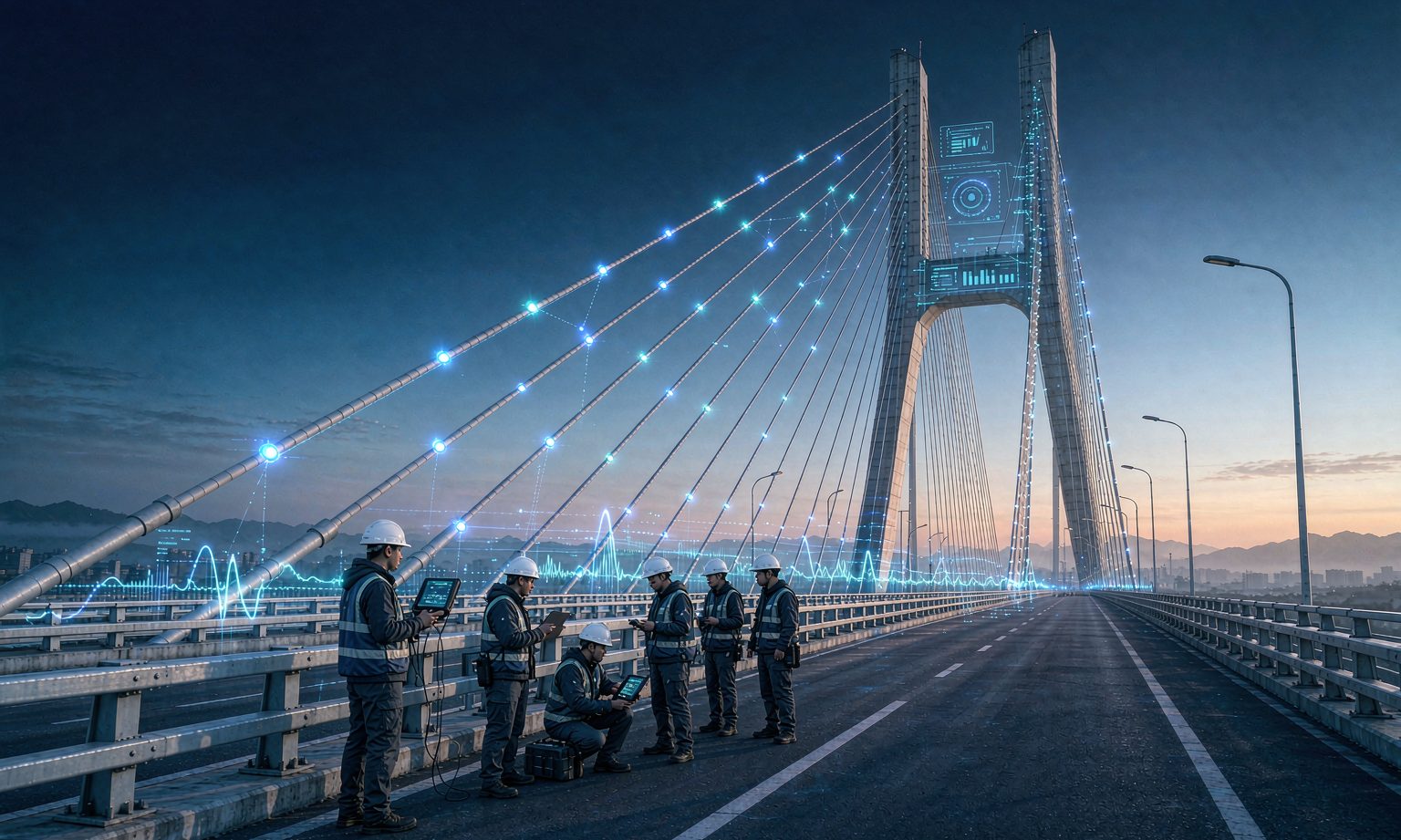
The consequence of this arithmetic: monitoring systems became the exclusive privilege of major bridges and key tunnels. Of China's more than 1.1 million highway bridges, the share actually equipped with online monitoring remains low, and a large number of small and medium bridges are still in a "periodic manual inspection" state. Since 2021, when the Ministry of Transport pushed the retrofit programme for aged and unsafe highway bridges and explicitly required pilot monitoring in some regions, the market gap has been clear — what was missing was precisely a technology package that a county-level budget could afford.
MEMS (micro-electro-mechanical system) accelerometers are aimed squarely at that gap.
II. What MEMS Is, and Why It Qualifies for Bridge Duty
The sensing structure of a MEMS accelerometer is "etched" onto a silicon wafer using semiconductor processes: a suspended proof mass is anchored to the substrate by micron-scale beams. Acceleration displaces the mass, changing the capacitance between movable and fixed comb fingers; measuring that capacitance change is equivalent to measuring acceleration. The entire sensing element plus signal-conditioning circuitry can fit within a 3 × 3 mm square — smaller than a grain of rice.
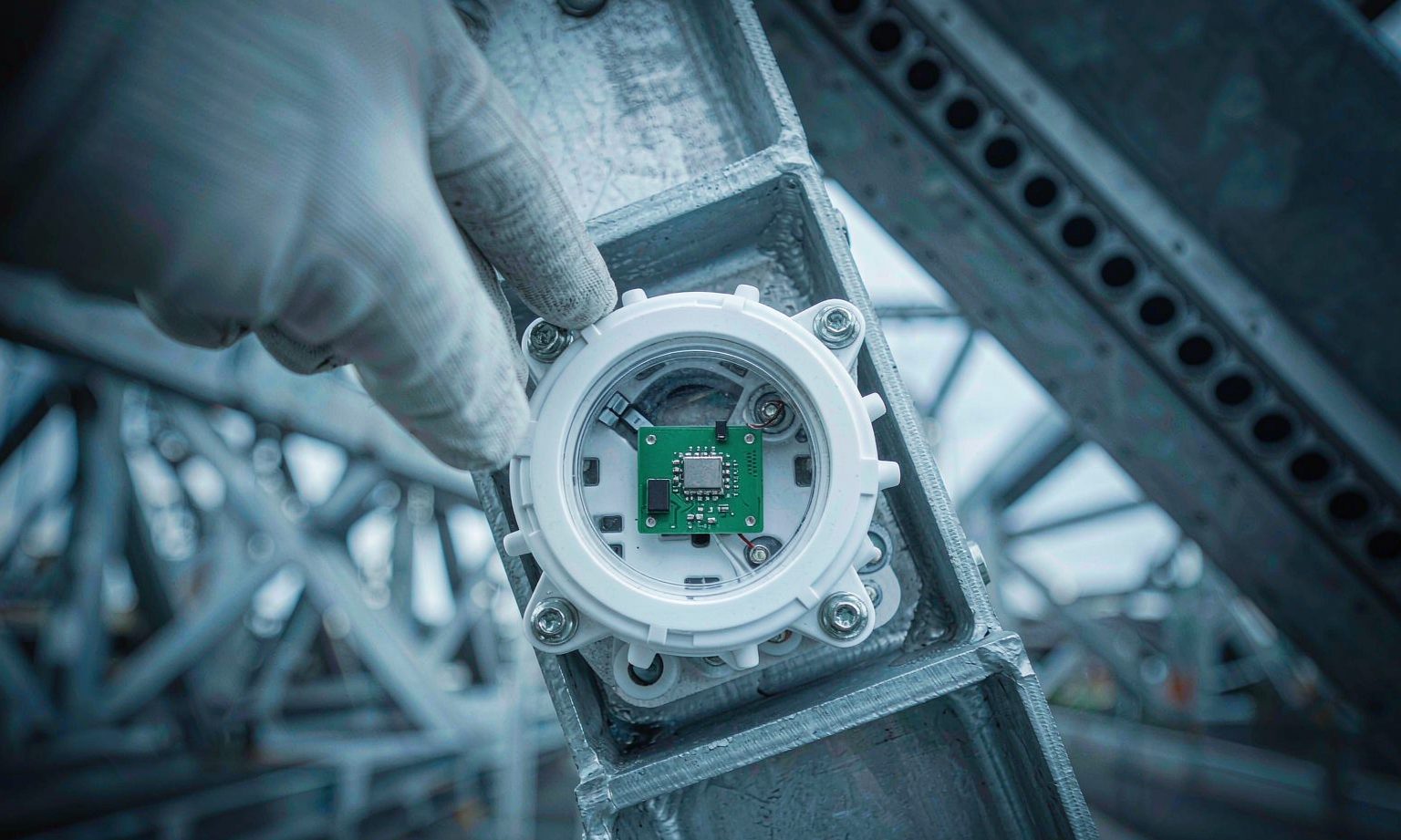
Its engineering credibility rests on three very real advances of the past decade:
- Noise density came down. Early consumer-grade MEMS devices had noise density above 300 μg/√Hz — hopeless for measuring structural micro-vibrations. Around 2020, industrial-grade products pushed noise down to the 25 μg/√Hz class, and in the past two years some high-performance models have reached below 5 μg/√Hz. Combined with narrowband filtering, the signal-to-noise ratio across a bridge's natural frequencies (typically 0.1–10 Hz) is now entirely adequate.
- Range and bandwidth cover engineering needs. Bridge vibration amplitudes mostly fall between 0.001 and 0.1g, with tunnel and slope vibrations somewhat higher. Configurable ranges of ±2g to ±16g and bandwidths from DC to several hundred Hz cover the whole spectrum.
- Digital output became standard. Mainstream industrial models output SPI/I2C digital signals directly, eliminating wiring errors and interference from analogue chains, and a single MCU can manage multiple sensors simultaneously.
The price change is the most visible: industrial MEMS accelerometers cost from a few tens to a few hundred yuan per unit. Even adding enclosure protection, temperature compensation and wireless nodes, the all-in cost per measurement point can be pressed below one-tenth of a force-balance solution.
III. Versus Force-Balance and Fiber Optics: Layering, Not Replacement
Hailing MEMS as the "force-balance killer" would be irresponsible. The correct relationship among the three is layering.
Force-balance remains the high-precision benchmark: seismic monitoring, modal identification on super-long-span bridges, and any application demanding 0.1 mg resolution are irreplaceable territory. Since 2023, monitoring projects for extra-large bridges in several provinces still use force-balance or piezoelectric sensors at critical girder sections, with unit budgets unchanged. Its weaknesses are cost, bulk, and mediocre behaviour in the non-linear region beyond its dynamic range.
Fiber optics (FBG/distributed) excels at electromagnetic immunity and "one fiber, many points": stay cables of sea-crossing bridges, strain profiles of tunnel linings, intrinsically safe deployment in gassy environments — fiber is the only sensible choice. But its vibration-measuring capability is limited by the sampling rate and cost of interrogators; high-speed multi-channel interrogation equipment is not cheap, so deploying dense vibration arrays is rarely economical.
MEMS sits in the middle, leaning toward breadth: scenarios with many points, moderate per-point accuracy requirements and constrained budgets. The main navigation span of a river-crossing bridge gets "precision" coverage from fiber optics and force balance, while approach spans and ramps get "general" coverage from MEMS, with all data flowing into one platform. This "precision-plus-general" architecture is becoming the industry's mainstream practice.
A useful order-of-magnitude comparison: a force-balance point costs roughly 10,000–15,000 yuan all-in, an FBG vibration point about 5,000–8,000 yuan, and a MEMS wireless point about 800–2,000 yuan. With the same 300,000-yuan vibration budget, a force-balance scheme covers 20 points while a MEMS scheme covers 150 or more — and with higher point density, the spatial resolution of modal identification actually improves.
IV. Three Engineering Hurdles: Temperature Drift, Resolution and Installation
Putting MEMS on a bridge is not plug-and-play; three issues must be dealt with at the design stage.
The first hurdle is temperature drift. MEMS zero-offset and scale factor are both temperature-sensitive; industrial-grade zero-offset drift is typically ±0.1–0.5 mg/℃. A 50℃ seasonal swing on a bridge is normal, and without compensation the zero shift can drown the real signal. Practice addresses this on three levels: choose models with better drift specs (some automotive-grade products now achieve ±0.05 mg/℃); use on-chip or on-board temperature sensors for real-time compensation; and apply a temperature-versus-zero regression model at the data layer for secondary correction. With all three done, long-term zero drift can be held within 1 mg — entirely sufficient for vibration measurement, which relies mainly on the AC component.
The second hurdle is low-frequency resolution. The first natural frequency of a long-span bridge may sit near 0.2 Hz, a 5-second period. MEMS low-frequency noise-integration performance trails force balance, and a direct time-domain waveform comparison will show the gap. The countermeasure is to play to strengths: treat MEMS points as frequency-domain indicators — natural frequencies, damping ratios, mode-shape correlation coefficients — which are precisely the most stable indicators of structural condition, and leave absolute displacement metrics to GNSS and hydrostatic levelling.
The third hurdle is installation and calibration. MEMS's small size is both a virtue and a trap: glued on casually, 5° of axis misalignment lets transverse sensitivity contaminate the signal. Engineering practice requires a levelled mounting surface (spirit level or laser alignment), alignment with the bridge axis, and fixing with epoxy or mechanical clamps, plus bench calibration before batch installation. These procedures are not complicated, but they determine whether the data is usable — more than half of the "data anomalies" in the monitoring industry turn out, on investigation, to be installation problems.
V. Field Practice: Low-Cost Networking Is Proving Itself
MEMS deployment paths have crystallised over the past two years, and three typical use patterns are already producing value.
Fleet-wide screening of bridge groups. Some municipalities have fitted MEMS wireless vibration nodes on dozens of small and medium bridges under their jurisdiction — 4 to 8 points per bridge, backhauled over LoRa or 4G Cat.1, sampling at 100 Hz, with a scheduled daily natural-frequency scan. The system tracks natural-frequency drift trends for each bridge and pushes alerts when a frequency drops more than 3% or inter-point correlation becomes anomalous. Hardware investment is 10,000–20,000 yuan per bridge — a fraction of what one bridge's force-balance scheme used to cost — letting the maintenance authority achieve full online coverage of its bridge fleet for the first time.
Bridging construction and operation phases. Tunnels and bridges need temporary monitoring during construction for blasting and adjacent works, and the system should not be wasted afterwards. MEMS nodes are cheap and recoverable: installed during construction, then converted to formal monitoring or moved to the next site. A highway project in southwest China placed 60 MEMS points on tunnel secondary-lining sections to monitor blasting vibration, and recovered over 80% of the equipment after completion.
Complementing existing precision systems. On extra-large bridges, the existing force-balance/fiber systems stay untouched while MEMS points densify their weak zones — approach spans, deck overlays, ancillary structures — raising point density from 1 per hundred metres to 1 per ten metres at low cost and improving damage-localisation capability. This "existing-plus-incremental" retrofit approach is far more acceptable to owners than tearing everything out and starting over.
The boundaries must be acknowledged too: in ultra-low-frequency (<0.1 Hz) and ultra-high-precision (<1 μg) applications MEMS still cannot replace traditional solutions, and long-term reliability data for some low-cost products remains thin — bulk purchasers should require at least five years of accelerated-ageing data from the vendor.
VI. Summary
MEMS accelerometers going on bridges is, at its core, a cost restructuring of the structural monitoring industry by semiconductor manufacturing: chip-scale sensing structures cut the per-point cost by an order of magnitude, moving the economics of monitoring systems from "exclusive to major bridges" to "affordable for county-road bridges." It will not replace force-balance or fiber optics; rather, it layers the monitoring architecture — the precision tier goes to traditional high-accuracy solutions, the general tier to MEMS, and both tiers share one data platform.
The key to field deployment lies not in the chip itself but in the systems engineering: thorough temperature-drift compensation, playing to frequency-domain strengths, and disciplined, standardised installation and calibration. For practitioners in the monitoring industry, the competitive focus over the next three years is unlikely to be "whose sensor is more accurate" — it will be "who can deploy ten times more points on the same budget, and make that data genuinely deliver early-warning value."