The Last Mile on Bridges, Tunnels and Slopes: Comparing Site Networking Technologies by Cost, Power and Scenario
Everyone who has delivered a monitoring project has seen this scene: the sensors are installed, yet not a single data point arrives. After hours of troubleshooting, the grating is fine and the interrogator is fine — a switch got flooded, two serial servers had an IP conflict, or the battery behind a solar panel on the slope starved during a week of rain.
The industry writes plenty about sensor selection, algorithm accuracy and data platforms, and very little about how data actually travels from sensor to cabinet. Yet on a real project, site networking is what decides success — and what decides whether the budget survives. It shapes data quality, and it locks in operations cost for the next five to ten years.
This article lays out the networking options for three typical assets — bridges, tunnels and slopes — and compares them on four dimensions: technical characteristics, cost, power consumption and fit.
First, Know This: Different Data Needs Differ by Three Orders of Magnitude
There is no one-size-fits-all network, because "monitoring data" spans an enormous range. Four classes cover most of it:
| Data class | Typical content | Sampling / reporting | Per-point bandwidth | Latency tolerance |
|---|---|---|---|---|
| Slow variables | Temperature, humidity, settlement, tilt, water level | 1 min – 1 h | <1 kbps | Minutes is fine |
| Dynamic variables | Vibration, cable force, dynamic strain, acceleration | 50–200 Hz, continuous or triggered | 10–200 kbps | Seconds |
| Image / video | Crack capture, intrusion, inspection footage | Event-triggered or scheduled | 2–20 Mbps | Seconds, jitter OK |
| Control & config | Parameter push, device restart | Occasional | Very low | Seconds, must be reliable |
Keep this table in mind and every selection decision gets simpler: slow variables make up ~80% of the point count but consume under 5% of the bandwidth. Plenty of projects lay gigabit fiber across an entire site only to carry temperature and water level on it — textbook over-engineering.
Wired Technologies: The Baseline for Stability
Industrial Ethernet + PoE: The Most Universal, and the Easiest to Get Wrong
Standard Ethernet (100/1000BASE-TX) tops out at 100 m per segment — a physical limit, not a product one. On site it has two clear advantages: bandwidth is ample, so video, vibration and configuration share one cable; and PoE (802.3af/at, 15.4 W/30 W) delivers power over the same cable, eliminating per-point power construction — on a bridge, that means dozens fewer waterproof junction boxes.
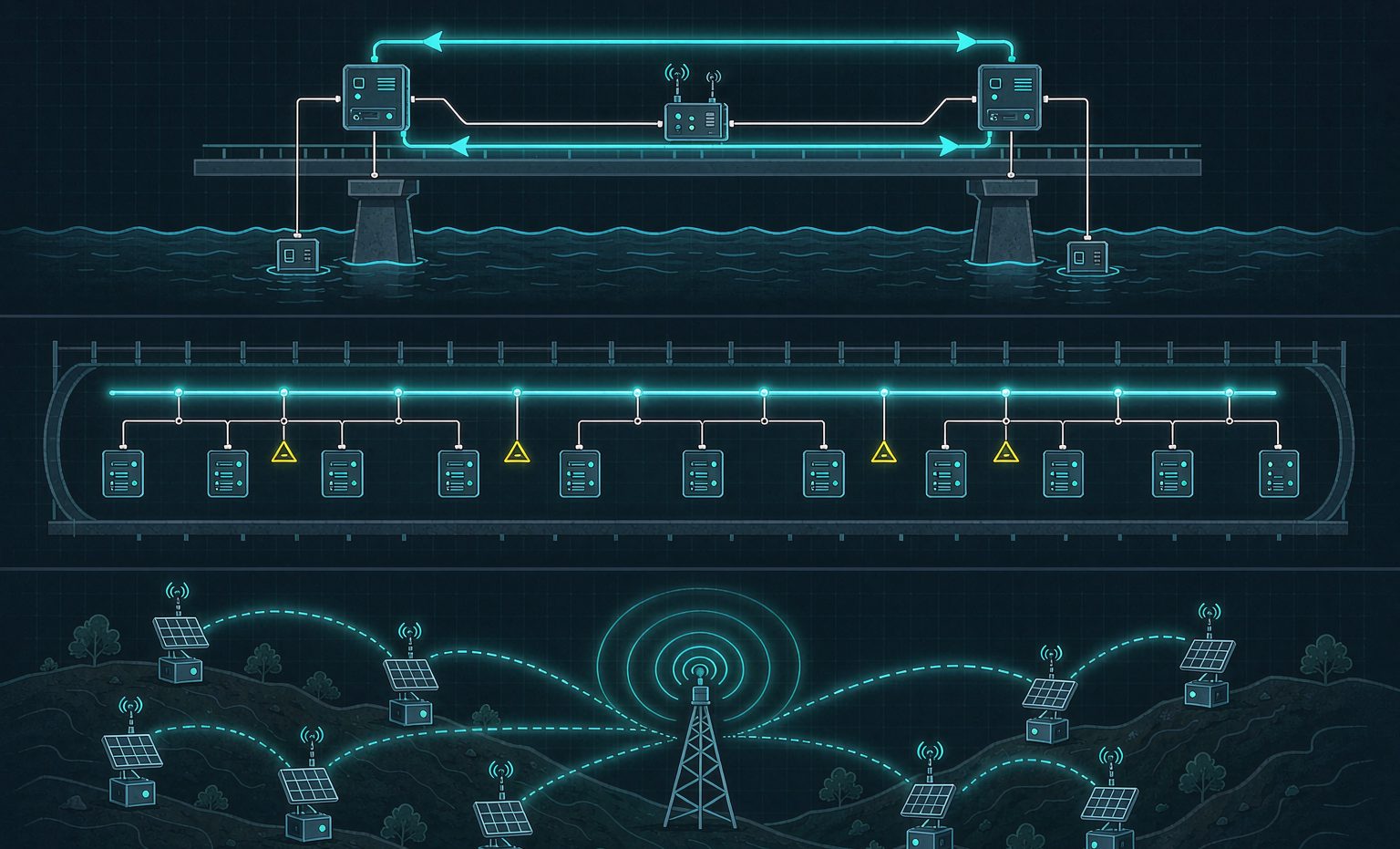
But it has two hard constraints: 100 meters and a star topology. Bridge decks run hundreds of meters to several kilometers, so switches cascade outward — and every cascade level adds failure points, where one power loss can black out half the bridge. The correct field pattern: Ethernet only for "the last segment" (sensor → local cabinet), and fiber ring networks between cabinets.
Fiber Ring Network: The Standard Answer for Bridge and Tunnel Backbones
Industrial switches in a ring running ERPS (or a vendor ring protocol) heal a broken fiber in under 50 ms — effectively invisible to the monitoring system. Single-mode fiber reaches 20–80 km and is inherently immune to electromagnetic interference and lightning surge, both of which are non-negotiable on bridges (catenary lines, VFDs, thunderstorms) and in tunnels (traction power, ventilation VFDs).
The cost shows up in hardware and construction: industrial ring switches run from a few thousand RMB to over ten thousand each, and fiber laying demands cable trays, conduit, splicing and testing. But the marginal per-point cost is low — a 12-core cable using 2 cores leaves 10 for future video, broadcasting or fire systems, with no additional civil works. Over a ten-year horizon, a ring network is usually the cheapest option.
EPON / GPON: The Value Play for Long Tunnels
EPON replaces the switch with passive splitters: one OLT at the head end, a 1:8 or 1:16 splitter every 1–2 km inside the tunnel, and an ONU feeding the acquisition equipment a network port. Everything in between is unpowered — and that is its biggest virtue, because in a long tunnel every active cabinet is one more thing to inspect, one more failure mode, one more power dependency.
A single fiber carries 32–64 ONUs sharing 1.25 Gbps downstream. The drawbacks are shared bandwidth and trickier fault isolation: a break beyond the splitter can only be chased segment by segment with an OTDR. For tunnels longer than 3 km, EPON's total cost of ownership usually beats a chain of cascaded switches.
RS-485 / Modbus: Cheap — Just Don't Run Dynamic Data on It
A two-wire differential bus reaching 1,200 m at 9,600 bps, carrying 32–128 nodes per segment, with devices costing tens to a few hundred RMB. It is the cheapest wired option, and much of the field fleet — weather stations, water-level gauges, inclinometers — speaks 485 natively.
The weaknesses are equally clear: half-duplex, no arbitration, narrow bandwidth. If polling one node takes 200 ms, 32 nodes take 6.4 s per sweep — fine for temperature, hopeless for vibration. And a bus is a "one fault stops all" topology: a shorted node drags the whole line down, so branch protection and termination resistors are mandatory in the field.
CAN: The Local Artery for Dynamic Acquisition
CAN provides hardware arbitration and multi-master operation, running 1 Mbps over 40 m — ideal for pooling a cluster of high-frequency nodes (say, eight accelerometers on one cross-section) locally before an edge gateway converts to Ethernet for the uplink. It is mature in automotive and industrial control, more interference-tolerant than 485, and a misbehaving node drops off the bus without taking it down.
It is not a long-haul or campus-wide technology — think "inside the cabinet / inside the section". A sound field combination: sensors → CAN/485 local aggregation → edge gateway → fiber ring.
Wireless Technologies: Solving "Can't Get In" and "No Power"
Wi-Fi 6: Bandwidth to Spare, Power and Coverage to Fight
Wi-Fi 6 (802.11ax) delivers hundreds of Mbps per AP in practice — right for video backfill, inspection tablets and commissioning-time connectivity. But on site it has three problems: high client power draw (300–800 mW while transmitting, impossible for long-term battery nodes), limited coverage radius (leaky cable or directional antennas in tunnels, APs on structural members on bridges), and co-channel interference in the 2.4/5 GHz bands.
Verdict: Wi-Fi suits people and video, not sensors that must stay online for years.
LoRa / LoRaWAN: The Practical Answer for Slopes and Scattered Points
Sub-GHz (470–510 MHz in China), sensitivity down to −137 dBm, 3–10 km line-of-sight, hundreds to thousands of nodes per gateway, ~30–120 mA transmit current and microamp-level sleep. For slopes — scattered points, no utility power, no fiber, solar-plus-battery only — LoRa is nearly always the most economical choice today.
The price is data rate: 0.3–50 kbps with duty-cycle limits, and messages of a few dozen bytes. It is born for slow variables — displacement, rainfall, moisture, tilt reporting hourly — and simply not a vehicle for vibration waveforms.
NB-IoT: No Network to Build, but Do the Math on Fees and Coverage
It rides the carrier network, with 20 dB more link budget than GSM — basements, tunnel portals and bridge undersides can still connect. PSM/eDRX modes stretch batteries to 5–10 years. You skip gateways and self-built network maintenance, paying instead with a SIM per point (tens of RMB per year), second-to-minute latency per transmission, and data flowing through carrier platforms.
It fits "scattered points, no local network, not worth a gateway": supplementary monitoring, temporary densification, flood-season emergency observation.
ZigBee / BLE Mesh: Short-Range Self-Organizing, for In-Tunnel Gap Filling
Both are short-range, low-power mesh technologies — tens of meters per hop, stretching to a few hundred by multi-hop. Inside tunnels they have value as gap-fillers alongside a LoRa or fiber backbone (for example, interconnecting a dozen sensors within one section), but mesh stability and O&M complexity grow with hop count. Do not make them the backbone.
4G / 5G: Reserved for "High Volume" and "Mobile"
4G modules peak at 1–2 W, 5G at 2–4 W — fatal for solar-powered always-on nodes. Their right role: video backhaul, emergency command, mobile inspection vehicles, and a backup path when fiber breaks — not the main channel for hundreds of sensors.
The Power Ledger: What Decides Whether a Slope Project Survives
Power is not a datasheet number; it converts directly into solar panel and battery size — that is, into money and maintenance.
| Technology | TX power draw | Sleep / idle | Battery-feasible? | Typical supply |
|---|---|---|---|---|
| RS-485 / CAN | 10–50 mW | Low | Yes (scheduled wake) | Local 12/24 V + solar |
| Industrial Ethernet | 1–3 W (incl. switch share) | None | No | Mains / PoE |
| EPON ONU | 2–5 W | None | No | Tunnel lighting circuit |
| Wi-Fi 6 | 0.3–0.8 W (client) | Seconds | Marginal (big battery) | Mains / PoE |
| LoRa | 100–400 mW burst | µA level | Fully | Primary lithium, 3–5 y |
| NB-IoT | 0.5–1 W burst | µA level (PSM) | Yes | Lithium 5 y+ |
| 4G | 1–2 W peak | mA level | Hard | Mains + UPS |
| 5G | 2–4 W peak | mA level | No | Mains |
A field rule of thumb: design slope nodes for ≤5 Wh per day, pair with a 20 W panel and a 12 V/20 Ah battery, and the node rides out 5–7 consecutive rainy days. Swap in an always-on 4G modem and the same setup dies within two days. When a slope monitoring system "works all summer and goes dark in winter", nine times out of ten the power budget had no margin.
The Cost Ledger: The Expensive Part Is Not the Equipment
Take a 1 km bridge with 30 monitoring sections and about 120 measurement points, and spread the bill (order-of-magnitude, varying by region and workmanship):
| Cost item | Share | Notes |
|---|---|---|
| Trenching / trays / conduit civil works | 35%–50% | Bridge trays, tunnel wall mounting, slope trenching — costliest and hardest to change |
| Fiber / cable materials | 10%–20% | Single-mode fiber ~2–6 RMB/m; shielded signal cable costs more |
| Network equipment | 15%–25% | Industrial switches, OLT/ONU, gateways, APs |
| Labor, splicing, testing | 10%–20% | Splicing, termination, labeling, OTDR reports |
| Lightning protection & grounding | 5%–10% | Non-negotiable on bridges and exposed slopes |
| Ten years of O&M | Varies by design | More active nodes = costlier operations |
This table explains a familiar phenomenon: a fiber ring network costs more up front, yet is often cheaper over ten years — fewer failure points and fewer replacements. Wireless saves civil works but shifts cost into battery swaps, gateway upkeep and signal hunts. If you compare only equipment quotes, the conclusion will almost always be wrong.
Proven Network Designs for the Three Asset Types
Bridge (river/valley crossing, 2–3 km)
Backbone: a 12–24-core single-mode cable along the deck tray, industrial switches at both abutments forming an ERPS ring; section cabinets carry industrial switches with PoE feeding the data loggers; high-frequency vibration points aggregate locally over CAN to an edge gateway before uplink. Keys: run the fiber in a dedicated grounded tray with both ends bonded, and equal-potential grounding in the cabinets.
Tunnel (3–10 km)
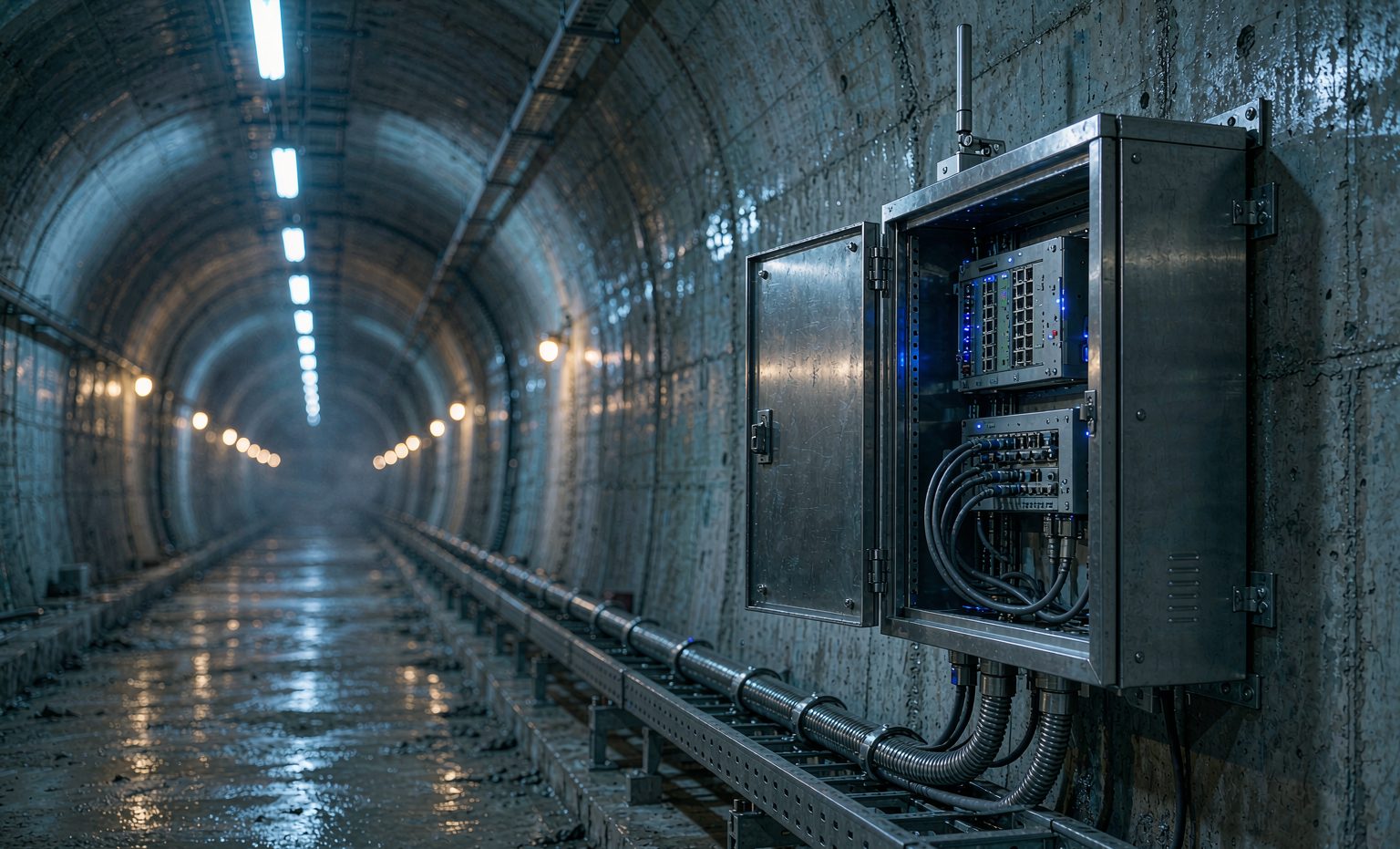
Backbone: in-tunnel fiber + EPON, a splitter every 1–2 km, wall-mounted ONU boxes on the lining; environmental and convergence points aggregate over RS-485; video rides a separate fiber (never mixed with monitoring traffic); no GNSS inside, so the central room provides unified PTP/NTP timing. Keys: IP66 ONU boxes, 5% slack in every cable section, bonding into the tunnel grounding grid.
Slope (scattered, no utility power)
Design: a LoRa gateway at the crest or toe where mains exists, nodes engineered for 3–5-year battery life reporting slow variables every 30–60 minutes; a 4G backup link on critical sections; the gateway aggregates and returns to the center over fiber or 4G. Keys: raise node antennas, keep them clear of metal mesh and dense vegetation, and power the gateway from its own solar supply.
Seven Pitfalls That Trip Up Field Teams
- Lightning and grounding: on bridges and hilltops, a network cable is a lightning rod. Bond or ditch the metallic strength member (or use all-dielectric cable), keep cabinet grounding resistance under 4 Ω, and fit surge protectors on network ports.
- Electromagnetic interference: traction power in tunnels and VFD fans on bridges are brutal sources. Use shielded twisted pair grounded at one end, separate power and signal in different trays, keep ≥30 cm apart.
- Clock desynchronization: cross-section vibration correlation requires millisecond-level common time. NTP gets you tens of milliseconds; for dynamic monitoring deploy PTP (IEEE 1588).
- Missing IP/VLAN planning: devices multiply, addresses collide, broadcast storms follow. Publish an address plan before commissioning and split monitoring, video and management into separate VLANs.
- PoE distance violations: beyond 100 m devices brown-out and reboot in loops — which eventually kills cameras. Add extenders or move to fiber with local power.
- Wireless co-channel chaos: overlapping LoRa gateways and Wi-Fi channels push packet loss through the roof. Do a spectrum survey during site reconnaissance.
- Unmonitored active nodes: nobody notices a dead switch, ONU or gateway until data stops. At minimum, bring network devices into the platform with SNMP or heartbeat — otherwise outages are discovered only by people.
Closing Thoughts
There is no "best" site network — only a matched one. The decision compresses to three sentences:
Mains power, ducts, high reliability → fiber ring; long distance, minimal maintenance, tunnels → EPON; no power, scattered points, slow variables only → LoRa / NB-IoT.
The real watershed is not the equipment selection sheet but two disciplines: account for the network's ten-year bill, civil works and O&M included; and leave margin in the power budget — because nearly every field outage eventually traces back to a battery or a lightning strike.