
Data Stays Local, Models Still Grow: Federated Learning and Edge Intelligence for Structural Monitoring
The bridge and tunnel monitoring industry has long been stuck in a contradiction: no matter how much monitoring data a single bridge or a single tunnel accumulates, it only covers one structural form and a narrow slice of operating conditions, so the AI models trained on it generalize poorly; pooling data from dozens or hundreds of bridges would immediately raise the value by an order of magnitude — but the data simply won't pool.
The reason is not technical — it's ownership and liability. Monitoring data touches the interests of owners, design institutes, contractors, operators, and equipment suppliers alike. It contains both benefit-related data (maintenance costs, traffic loads) and sensitive information (structural defect records directly affect acceptance and accountability). Getting anyone to hand over raw data for centralized training requires careful weighing. That is exactly why many "regional monitoring big-data platforms," once built, end up ingesting only ten to twenty percent of their designed capacity.
Federated Learning: Send the Model to Where the Data Lives
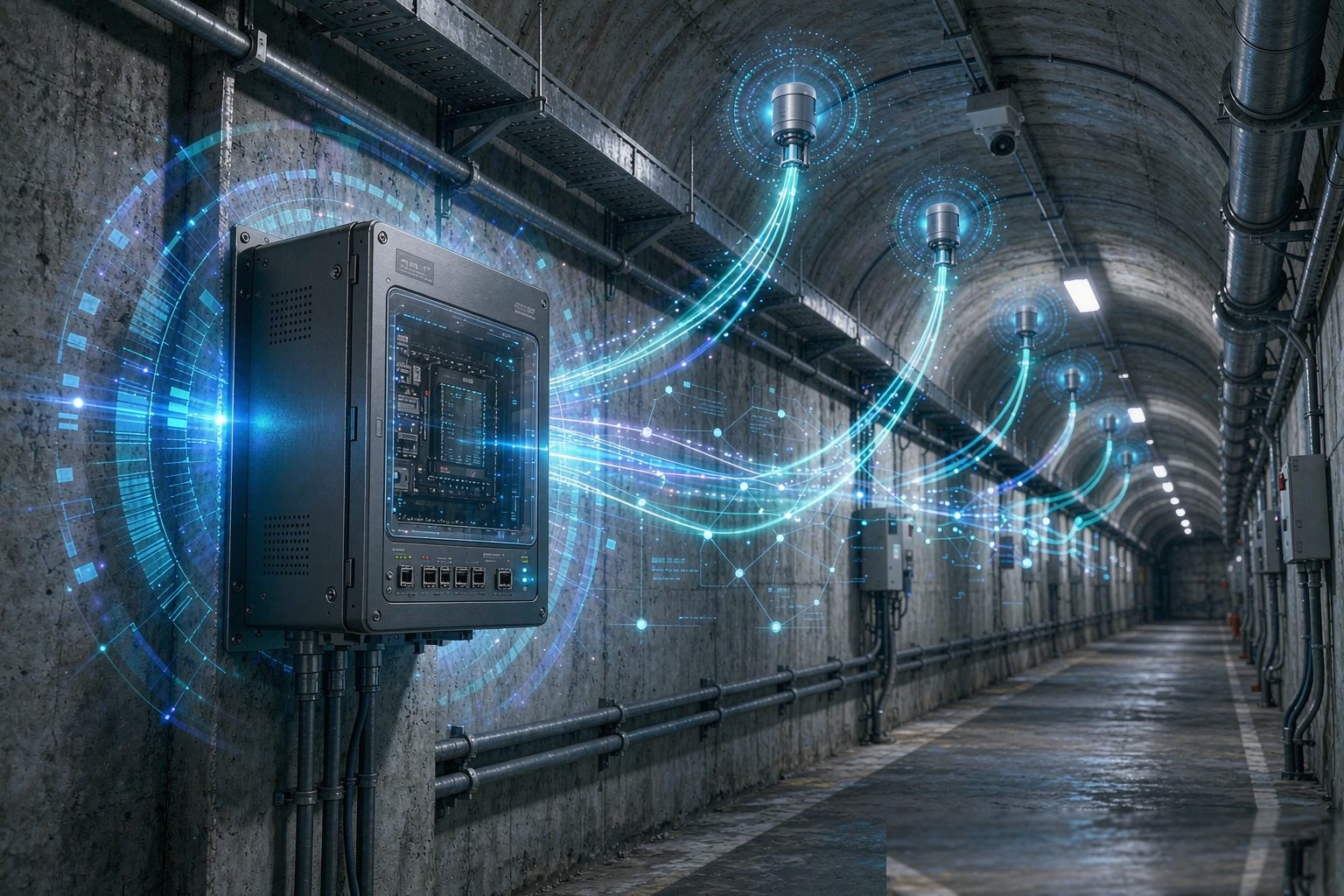
Federated Learning (FL) is designed precisely to break this deadlock. Its core idea is to invert the training process: instead of moving data to the model, move the model to where the data lives.
The workflow goes like this: a central server distributes an initial model; each participant (say, the edge server of each bridge) trains on its local data and sends back only the updated model parameters (gradients); the central side aggregates everyone's parameters (FedAvg weighted averaging is the most common method) to produce a "well-traveled" global model, which is then redistributed for the next round. Throughout the entire process, raw monitoring data never leaves the local server.
For bridge and tunnel monitoring, this architecture fits surprisingly well:
Cross-project model training. Different bridges differ greatly in sensor layout, structural form, and traffic volume, but the physics of damage evolution is universal. A damage identification model trained via federated learning effectively learns data patterns from dozens of structure types and hundreds of operating conditions, with generalization far beyond any single-bridge model. Chinese transportation research institutes have already piloted "bridge-group federated modeling" at the provincial scale: the crack identification models of participating bridges improved in accuracy by an average of 8 to 12 percentage points compared with independent single-bridge training.
Compliance as a hard requirement in sensitive scenarios. Structural defect data and load over-limit records stay local at the bridge end; only abstracted model parameters leave the network — a naturally advantaged position from a data-compliance perspective. This removes the single biggest obstacle to multi-party collaboration.
Continuous evolution through compute reuse. Edge servers handle real-time analysis during normal operation and run federated training tasks during idle periods (such as nighttime traffic troughs), reusing compute without adding cloud burden.
Edge Intelligence: A Prerequisite for Federated Learning — and a Standalone Value
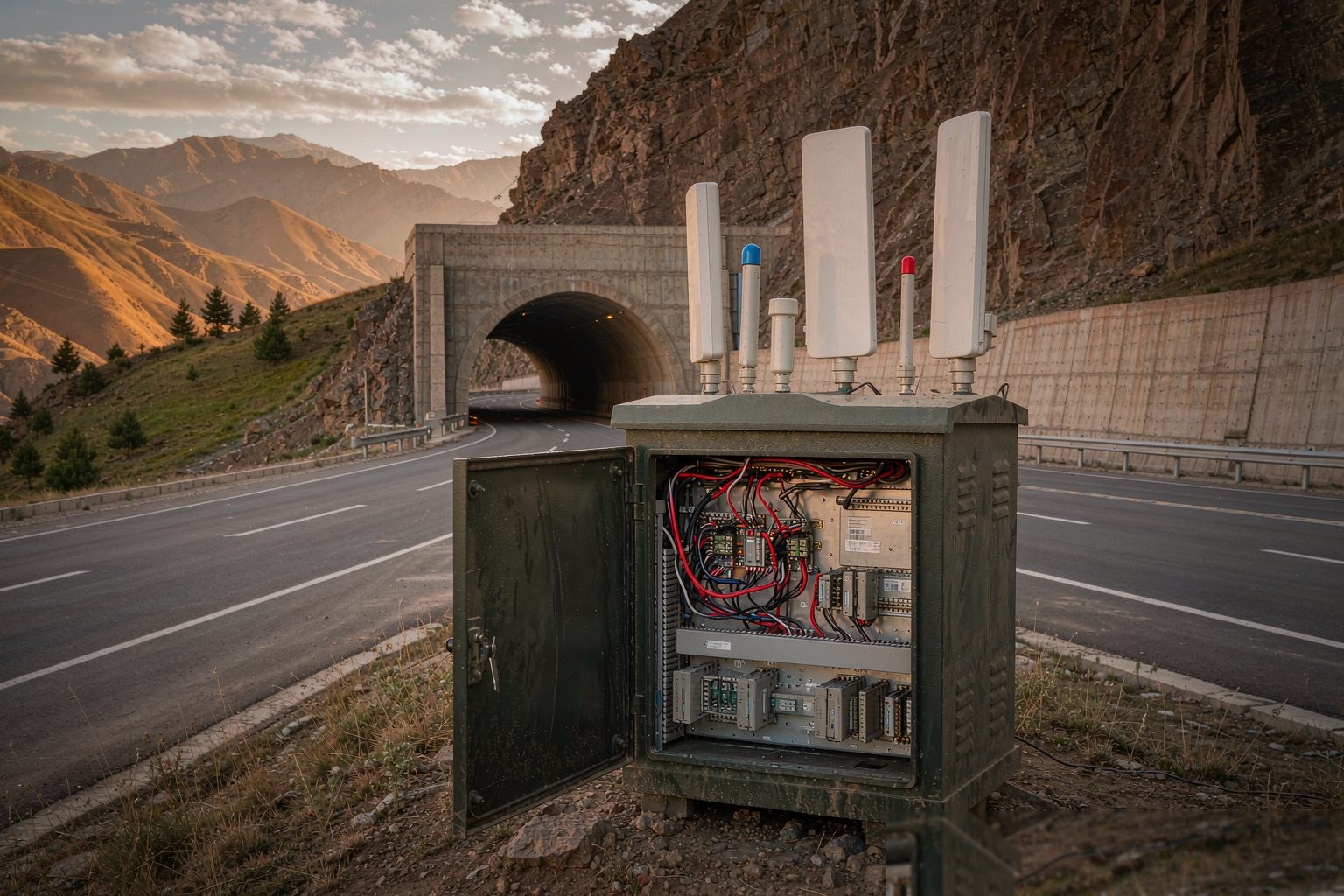
For federated learning to run in a monitoring scenario, each bridge end needs sufficient local compute — exactly what the rapid maturation of edge intelligence hardware in recent years has enabled.
The edge computing gateways of 2026 are no longer the "data passthrough boxes" of the past. An industrial-grade edge gateway (a few thousand to ten thousand yuan) typically carries 10 to 50 TOPS of AI inference compute, running quantized anomaly detection models with ease. The sensible division of labor for edge compute in a monitoring system is:
Must stay at the edge: real-time over-limit judgment and emergency alarms (millisecond response, cannot depend on the network); preprocessing and feature extraction of high-frequency vibration data (raw waveforms run to tens of thousands of points per second — compressing them into features at the edge before uploading saves over 95% of bandwidth); local store-and-forward buffering during link outages.
Well suited to the edge: local training tasks for federated learning, routine single-bridge health assessment, license plate recognition and load estimation for video AI inspection.
Better left in the cloud: cross-bridge comparative analysis and baseline modeling, trend prediction requiring long-term historical data, and full-scale simulation of digital twins.
A common pitfall is "over-provisioning edge compute." Some solutions equip every bridge with edge compute equivalent to a small server, only for it to idle 90% of the time. The rational approach is to size hardware against the actual load of three tasks — alarm response, feature extraction, and intermittent training — and to reserve 30% headroom rather than prepaying for imagined requirements.
Four Practical Problems You Cannot Avoid in Deployment
Federated learning plus edge intelligence does not produce value the moment you plug it in. Four practical issues must be resolved at the design stage:
Inconsistent data standards are killer number one. Sampling rates, units, sensor models, and naming conventions vary wildly across bridges, yet federated learning requires all participants to share a consistent definition of "the same feature." Field experience says invest heavily in data alignment first — unifying feature dictionaries, timestamp conventions, and outlier-cleaning rules. This step typically consumes more than a third of the project effort and cannot be skipped.
Model heterogeneity. Sensor layouts differ across bridges, so local models may have different input dimensions. The mainstream solution is split learning: each bridge handles low-level feature extraction on its own, while the upper-level damage discrimination model uses a unified shared structure. When choosing a framework (Flower, FATE, TensorFlow Federated, etc.), verify its support for heterogeneous models.
Communication and aggregation costs. Model parameters travel between bridge ends and the center every aggregation round — several to tens of MB per round. Fortunately, federated training has no real-time requirement: schedule it during nighttime troughs over the public network. If a bridge end uses satellite backhaul as its primary link, keep model size and aggregation frequency in check.
Who leads, who benefits. Federated learning is a multilateral collaboration mechanism that needs a neutral lead party (usually the industry regulator, a research institute, or the platform operator) to define data agreements, model ownership, and benefit sharing. If incentive mechanisms such as "bigger contributor, earlier access to new models" are poorly designed, participants lose motivation after two training rounds — no matter how elegant the technical solution, a broken mechanism means idle motion.
A Pragmatic Path to Get Started
For organizations looking to test the waters, take three steps rather than jumping straight into large-scale federation:
Step 1: Deliver edge value first. Even without federation, edge intelligence pays for itself: real-time alarms, bandwidth compression, and store-and-forward are three benefits a single-bridge project can realize immediately. Normalize edge-side data standards along the way to lay the foundation for future federation.
Step 2: Start with a small homogeneous federation. Pick three to five bridges with similar structural forms and identical sensor schemes (for example, a batch of continuously built continuous girder bridges) for a small-scale federated pilot. Run through the complete "distribute-train-aggregate-redistribute" loop and accumulate experience in mechanism design.
Step 3: Expand into a heterogeneous federation. With small-federation experience in hand, gradually onboard bridges with different structures and sensing schemes, introducing split learning to handle model heterogeneity.
At bottom, federated learning changes not algorithmic accuracy but the mode of collaboration: it makes "data never leaves home" and "models grow together" simultaneously true for the first time. For the bridge and tunnel monitoring industry — with its complex ownership and high sensitivity — this may matter more than the algorithms themselves. Technology solves whether computation is possible; mechanisms solve whether parties are willing to compute together. Only when both succeed does the industry's data dividend truly begin to be released.