
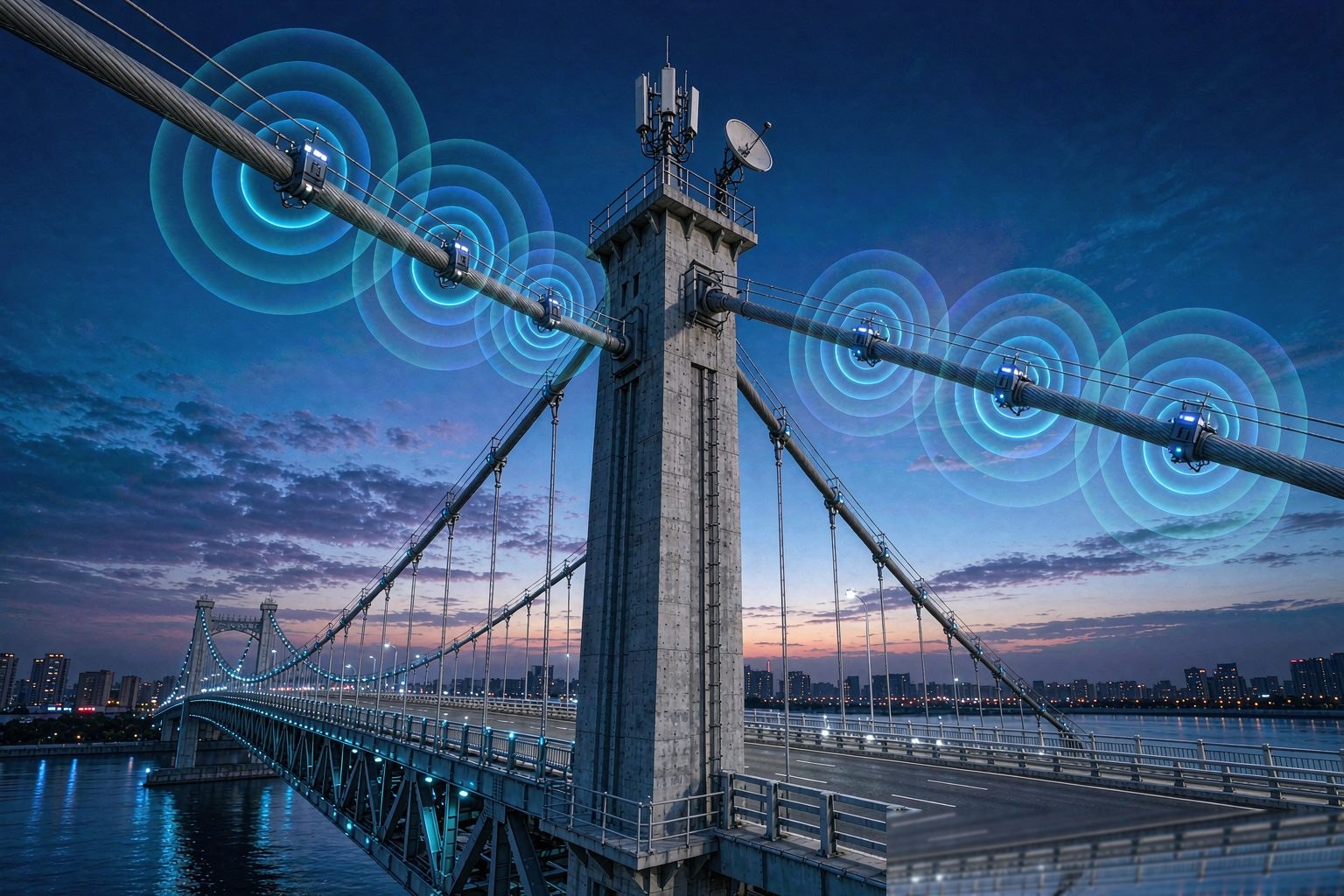
From 5G-A to Satellite IoT: Rewriting the Data Backhaul of Bridge & Tunnel Monitoring
In October 2026, a quiet transformation at the communication layer is reshaping the data backhaul landscape of the bridge and tunnel structural monitoring industry. The pain point of the past was straightforward: sensors keep getting cheaper and more numerous, but the backhaul link has always been the most fragile, most expensive, and most overlooked part of the entire monitoring system. Now this link is being rewritten by two forces at once — 5G-A/RedCap on the ground, and low-orbit satellite IoT in the sky.
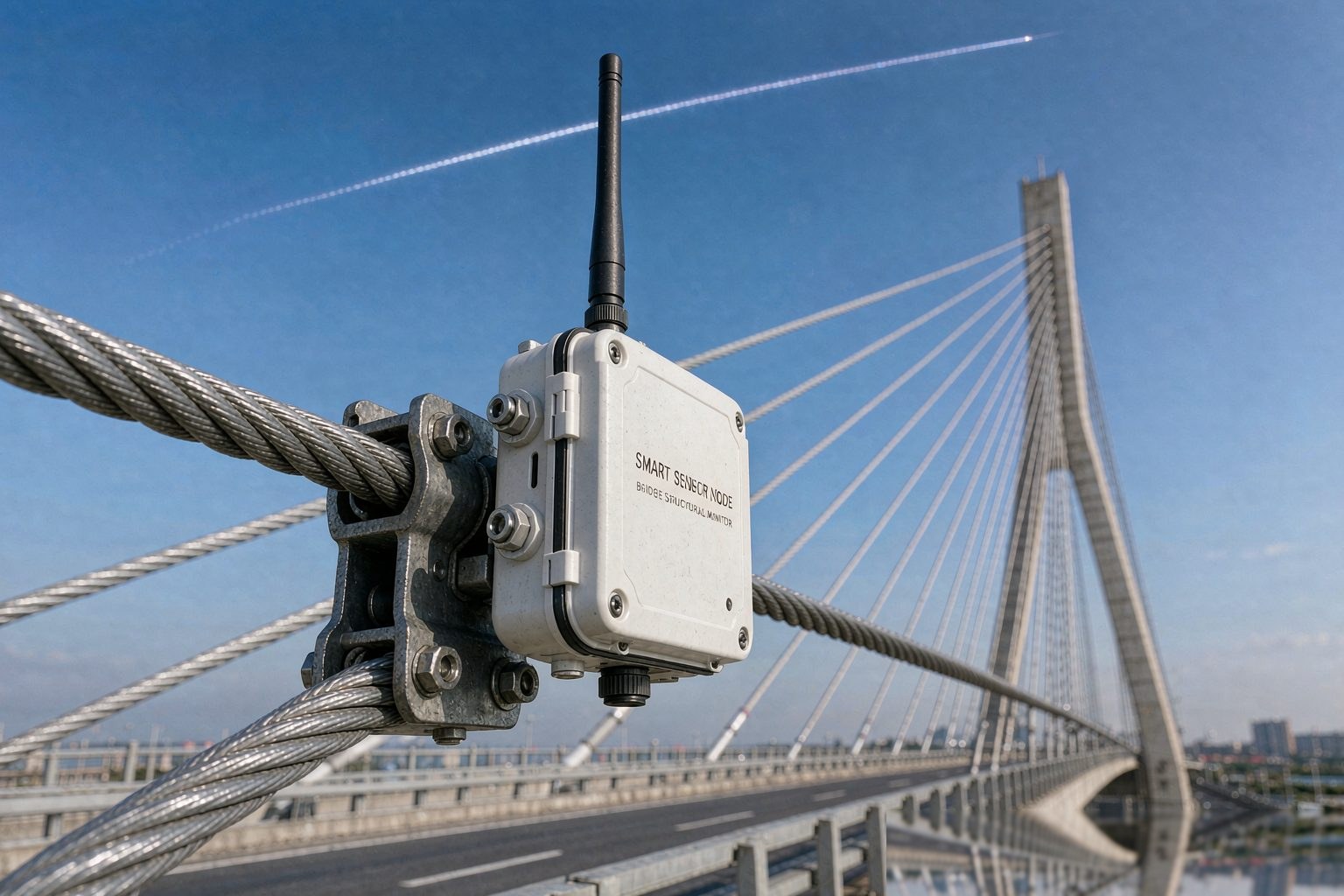
Why Data Backhaul Is the Chronic Headache of Bridge & Tunnel Monitoring
A typical bridge monitoring system easily involves hundreds or even thousands of measurement points, with sampling rates ranging from minute-level averaged reporting to kHz-level vibration capture. All of this data ultimately has to converge at the platform side, via one of two paths: a dedicated fiber line, or wireless backhaul.
Dedicated fiber is the most reliable option, but construction costs are prohibitive. For a cross-river bridge already in operation, the construction permits, traffic control, and deck trenching costs of pulling a new fiber across the bridge often exceed the cost of the monitoring equipment itself. Mountain expressway tunnels are even more troublesome — tunnel groups stretch for tens of kilometers, public network signal along the route comes and goes, and fiber has to follow the tunnel. With civil-engineering coordination costs so high, many projects abandon full-scale data backhaul at the design stage and fall back to a quasi-offline mode of "local storage with periodic manual export."
The old wireless trio (4G, LoRa, NB-IoT) each has its shortcomings: 4G data fees accumulate into a significant annual expense, and signal is weak in remote sections; LoRa's narrow bandwidth handles strain averages fine but struggles with acceleration waveforms; NB-IoT's uplink rate is even lower, suitable only for ultra-low-frequency short messages. The result is that many projects' data strategies are held hostage by their communication capabilities — sampling rates are set not by monitoring requirements but by how much data can be transmitted.
5G-A and RedCap: Driving Down the Cost of Cellular Backhaul
From 2025 to 2026, carriers' 5G-A (5G-Advanced) networks have been rolled out at an accelerating pace in China, bringing two direct benefits to the bridge and tunnel monitoring industry.
The first is the maturation of RedCap terminals. RedCap (Reduced Capability, lightweight 5G) is a branch of 5G tailored specifically for IoT: it strips out capabilities industry users don't need, such as large bandwidth and massive antenna arrays, cutting module costs from the several-hundred-yuan range of early 5G modules down to just over one hundred yuan, with power consumption dropping sharply as well. For monitoring terminals, RedCap's uplink rates (a few Mbps to tens of Mbps) are more than sufficient for strain, acceleration, and video frame extraction, with latency a full tier lower than 4G. By 2026, domestic RedCap connections had surpassed the ten-million mark, and with the module supply chain now at scale, "one 5G terminal per measurement point" makes economic sense for the first time.
The second is network slicing and QoS guarantees. 5G-A supports slicing services for industry users, letting monitoring data travel on a dedicated slice without competing with public traffic. For alert-type data (such as cable-force over-limit alarms), slicing can keep end-to-end latency stably within tens of milliseconds — a promise that best-effort 4G simply cannot make. Several provincial transportation groups have already begun bulk-purchasing 5G slicing services for bridge-group monitoring projects, writing "guaranteed alarm delivery" into the SLA.
The cost math is easy: a 5G-A industry dedicated data card costs roughly a few hundred to a bit over a thousand yuan per year in data fees — an order of magnitude lower than the annualized cost of building a dedicated fiber line. For budget-sensitive projects like small- and medium-span bridges, public-network 5G backhaul is becoming the default choice.
NTN Satellite IoT: Reliable Coverage for Uncovered Areas, at Last
What truly fills the coverage gap is satellite IoT (NTN, Non-Terrestrial Networks). For bridges in mountain gorges, sea-crossing passages far from shore, and tunnels through plateau permafrost sections, public network coverage is either absent or extremely unstable. In the past, these scenarios had no choice but to rely on self-built LoRa relays backed by manual inspection patrols.
The landscape in 2026 is completely different. Several major domestic low-orbit constellations have entered accelerated deployment, while existing satellite resources such as Tiantong and BeiDou short messages have reached large-scale commercial use in IoT. NTN-capable IoT modules have dropped to the hundred-yuan price level and support dual-mode switching — "use the terrestrial network when available, switch to satellite when it isn't." For monitoring terminals, this means:
- The alarm channel is always online. Under normal conditions, data travels over the 5G public network; once the link is interrupted or an over-limit event occurs, the system automatically switches to the satellite short-message channel to deliver critical alarms. The satellite channel has small bandwidth and per-message billing, carrying only messages of a few hundred bytes — such as "structural safety level + key metric summary" — so costs remain fully controllable.
- Fully satellite-based operation for extremely remote sites. For areas with zero public coverage, adopt a "local edge gateway aggregation + scheduled satellite backhaul" model: the gateway performs data compression and feature extraction locally, transmits compressed feature data via satellite once per hour, and uploads immediately upon event triggers. Field measurements from a tunnel-group project on a southwest China mountain expressway showed that the satellite backhaul mode's annual communication cost is about 1.8 times that of the public-network solution — but far lower than the hidden costs of "no backhaul at all, manual data retrieval" (labor, timeliness, and data-loss risk).
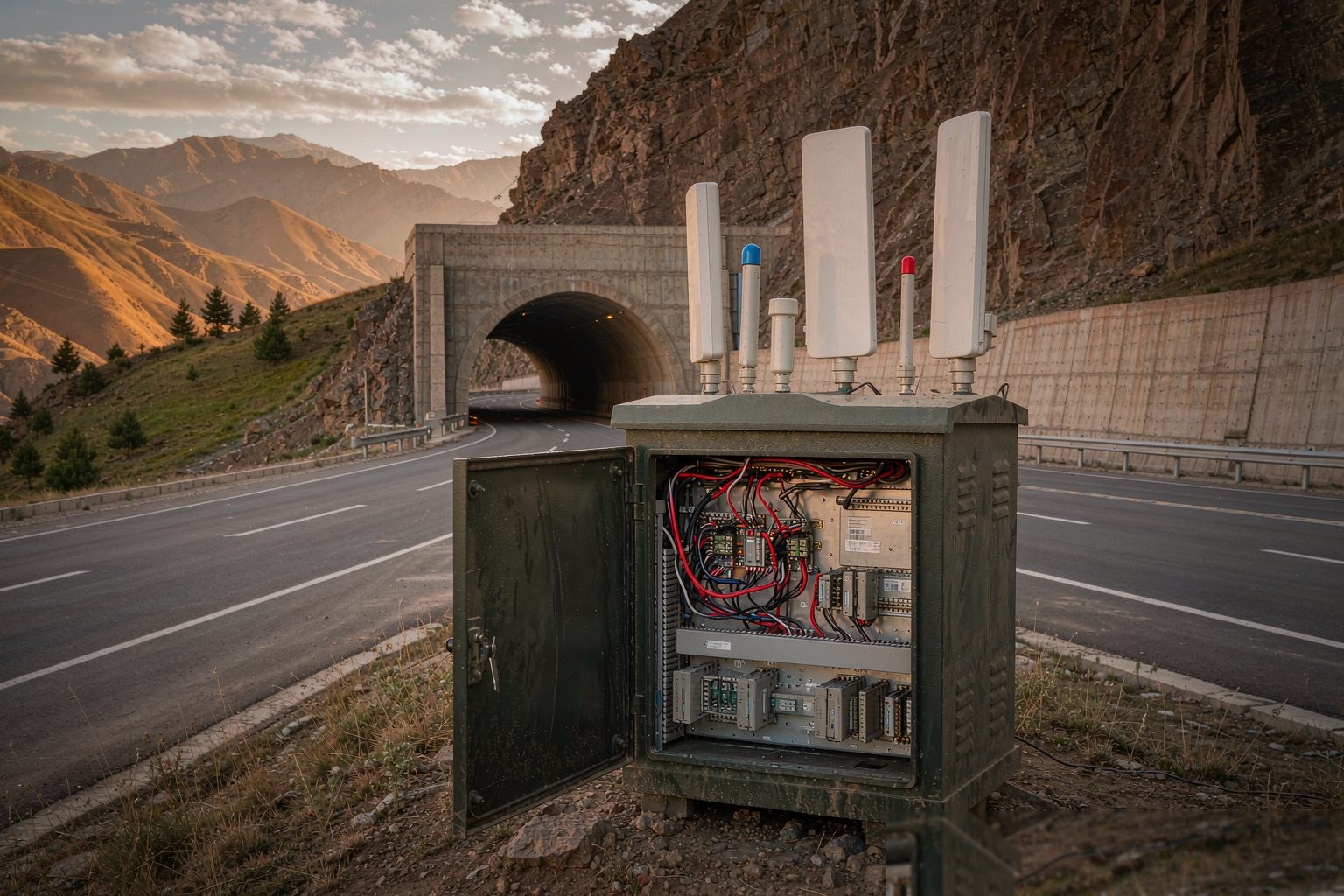
Choosing Among Three Routes: A Decision Checklist
For any specific project, the communication link choice boils down to three questions:
Question 1: Is there reliable public network coverage on site? If yes, and carriers provide 5G coverage along the route, prioritize 5G-A/RedCap public backhaul, with an uplink slice if budget allows. If only 4G is available, look at the data volume — low-frequency status data is fine over 4G; for high-frequency vibration or video, wait until 5G coverage is completed before enabling high-rate sampling.
Question 2: Does the data include "must-deliver" alarm requirements? For messages that cannot be lost — over-limit alarms, seismic triggers, anomaly events — it is advisable to add a satellite short-message backup alarm channel regardless of the primary link. A few hundred yuan a year in satellite service fees buys the certainty that "critical messages always get through."
Question 3: Is the project in a public-network dead zone? If yes, go with the "edge aggregation + satellite backhaul" architecture and put the emphasis on edge-side data governance — whatever data can be reduced locally should not be transmitted upward, because satellite bandwidth is precious.
Beyond the Link: Three Ways the Communication Layer Reshapes System Design
Improved communication capability is not just "more data, faster" — it feeds back into the design logic of the monitoring system itself:
Sampling strategies can now be "on-demand" rather than "bandwidth-constrained." In the past, many systems throttled vibration data that should have been sampled at 1 kHz down to 10 Hz extraction to save data fees — paying for good sensors and throwing away their value. With the backhaul bottleneck removed, high-frequency raw data can flow to the cloud in full, significantly improving the input quality of AI analysis models.
The role of the edge needs rethinking. Once communication is no longer the bottleneck, the criterion for "what stays at the edge, what goes to the cloud" shifts from "can it be transmitted" to "where does computation make more sense": latency-sensitive urgent decisions stay at the edge gateway, while models requiring global data for training live in the cloud. We will expand on this in our data analytics feature.
The communication link itself needs monitoring. Link availability, latency, and packet loss should be incorporated into the O&M dashboard as health metrics of the monitoring system itself. The industry has seen more than one incident where "the sensors were fine, the platform was fine, but the link in between silently died for a week and nobody noticed." Link heartbeats and dual-channel automatic failover should be standard capabilities of bridge and tunnel monitoring systems, not optional extras.
In one sentence: sensors are the eyes, the platform is the brain, and communication is the nervous system. The bandwidth, reliability, and cost of that nervous system determine the ceiling of the entire monitoring system. The maturation of 5G-A and satellite IoT amounts to equipping the industry with a nervous system that is "wide-coverage, low-cost, and always online" — the real worry going forward is wasting this link by pushing up piles of data nobody analyzes.